

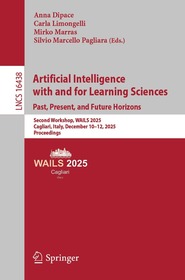
Artificial Intelligence with and for Learning Sciences. Past, Present, and Future Horizons
Second Workshop, WAILS 2025, Cagliari, Italy, December 10–12, 2025, Proceedings
Series: Lecture Notes in Computer Science;
-
GET 12% OFF
- Publisher's listprice EUR 53.49
-
22 184 Ft (21 128 Ft + 5% VAT)
The price is estimated because at the time of ordering we do not know what conversion rates will apply to HUF / product currency when the book arrives. In case HUF is weaker, the price increases slightly, in case HUF is stronger, the price goes lower slightly.
- Discount 12% (cc. 2 662 Ft off)
- Discounted price 19 522 Ft (18 593 Ft + 5% VAT)
19 522 Ft

Availability
printed on demand
Why don't you give exact delivery time?
Delivery time is estimated on our previous experiences. We give estimations only, because we order from outside Hungary, and the delivery time mainly depends on how quickly the publisher supplies the book. Faster or slower deliveries both happen, but we do our best to supply as quickly as possible.
Product details:
- Publisher Springer Nature Switzerland
- Date of Publication 17 February 2026
- ISBN 9783032176035
- Binding Paperback
- No. of pages256 pages
- Size 235x155 mm
- Language English
- Illustrations XXI, 256 p. 28 illus., 18 illus. in color. 688
Categories
Long description:
This book constitutes the refereed conference proceedings of the Second Workshop on Artificial Intelligence with and for Learning Sciences - Past, Present, and Future Horizons, WAILS 2025, held in Cagliari, Italy, during December 10-12, 2025.
The 13 full papers and 10 short papers presented in this book were carefully reviewed and selected from 24 submissions. They reflect the methodological and thematic breadth of contemporary research, spanning creativity-oriented and multimodal learning environments powered by artificial intelligence, fairness-aware and trustworthy educational technologies, teacher training, digital literacy, learning analytics, and inclusive and accessible learning ecosystems, among others.
MoreTable of Contents:
.-Adaptive Mental Health Interventions: Integrating VR and Generative AI in Learning Environments.
.-AI & Ethics Literacy in Secondary School: A Pilot Study.
.-AI and Universal Design for Learning: Perspectives for Accessible and Multimodal Teaching.
.-Artificial Intelligence and Virtual Labs. A controlled study of a teaching experience in an ITS Academy course..
.-Better Now: Bridging Theory and Practice in Blockchain-Enabled Educational Metaverse.
.-Biopedagogy, Artificial Intelligence, and Enactivism: Findings from a Mixed-Methods Study on 540 Education Professionals.
.-Combining Qualitative and Quantitative Insights within a Python Programming Blended Course.
.-Confidential Retrieval-Augmented Generation in Educational Contexts.
.-Enhancing Teacher Education: AI potential in anticipating teacher implicit biases through realistic simulations.
.-Experimenting with Generative AI in Screenwriting for Film Schools.
.-Exploring the Role of Professional Development in Fostering AI Competence among Teachers in Southern Switzerland.
.-Facilitating Information Extraction in Education by Translating Questions from Students, Instructors, and Managers into Knowledge Graph Queries through Large Language Models.
.-From functions to indicators: a framework to assess the impact of AI on self-regulated learning.
.-Hope, Aspirations, and the Impact of LLMs on Female Programming Learners in Afghanistan.
.-Inclusion as Embodiment: towards an integrated paradigm between Embodied Education, Inclusive Pedagogy and Artificial Intelligence.
.-Low-Resource Course Recommendation for Professional Training Associations.
.-Operationalizing Calibration for Fair Educational Artificial Intelligence.
.-Orchestrating Artificial Intelligence as Tool, Mediator, and Environment: Towards Inclusive Learning Ecosystems.
.-Using AI to train perspective primary school teachers to teach AI.
.-Virtual Pedagogical Agents in Educational VR for Neurodivergent Learners: A Literature Review.
.-AI Chatbots in Mathematics Classrooms: Understanding Student-AI Interactions and Teacher Integration.
.-Enhancing Digital Literacy through Retrieval-Augmented Generation.
.-Teaching AI literacy: how to enable students to adapt to the constant evolution of this field?
More
