

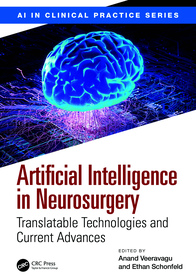
Artificial Intelligence in Neurosurgery
Translatable Technologies and Current Advances
Series: AI in Clinical Practice;
-
GET 10% OFF
- Publisher's listprice GBP 77.99
-
35 212 Ft (33 535 Ft + 5% VAT)
The price is estimated because at the time of ordering we do not know what conversion rates will apply to HUF / product currency when the book arrives. In case HUF is weaker, the price increases slightly, in case HUF is stronger, the price goes lower slightly.
- Discount 10% (cc. 3 521 Ft off)
- Discounted price 31 691 Ft (30 182 Ft + 5% VAT)
31 691 Ft

Availability
Not yet published.
Why don't you give exact delivery time?
Delivery time is estimated on our previous experiences. We give estimations only, because we order from outside Hungary, and the delivery time mainly depends on how quickly the publisher supplies the book. Faster or slower deliveries both happen, but we do our best to supply as quickly as possible.
Product details:
- Edition number 1
- Publisher CRC Press
- Date of Publication 5 October 2026
- ISBN 9781032748375
- Binding Paperback
- No. of pages240 pages
- Size 254x178 mm
- Language English
- Illustrations 7 Illustrations, black & white; 23 Illustrations, color; 5 Halftones, black & white; 19 Halftones, color; 2 Line drawings, black & white; 4 Line drawings, color; 12 Tables, black & white 700
Categories
Short description:
This groundbreaking text equips neurosurgeons with the foundational knowledge to navigate the complexities of AI in clinical practice. With a focus on real-world clinical data, fairness, and interpretability, the book addresses the critical hurdles of evaluation lag, dataset curation, and regulatory oversight.
MoreLong description:
The field of neurosurgery stands at the precipice of a transformative era, driven by the rapid evolution of artificial intelligence (AI). From optimizing patient selection and surgical parameters to enhancing intraoperative precision, AI has already begun to reshape the landscape of neurosurgical care. Yet, as these technologies advance from preclinical studies to real-world applications, the challenges of responsible integration, evaluation and safety have become increasingly urgent.
This groundbreaking textbook equips neurosurgeons with the foundational knowledge to navigate the complexities of AI in clinical practice. It explores the remarkable progress of AI systems, from machine learning–enhanced neuronavigation to agentic systems capable of autonomous, multistep workflows. With a focus on real-world clinical data, fairness and interpretability, the book addresses the critical hurdles of evaluation lag, dataset curation and regulatory oversight.
As AI transitions from passive tools to active participants in medical problem-solving, this text provides a roadmap for neurosurgeons to lead the charge in developing, implementing and critically assessing these transformative technologies. By bridging the gap between innovation and practice, this book ensures that the next generation of neurosurgeons is prepared to harness the full potential of AI while safeguarding patient care.
MoreTable of Contents:
Chapter 1: Neurons to Networks – Introducing the Role of Artificial Intelligence in Modern Neurosurgery
Chapter 2: Multimodal Foundation Models for Healthcare
Chapter 3: From Data to Decisions: AI-Driven Outcome Prediction in Spine Surgery
Chapter 4: Outcome Prediction in Brain Surgery
Chapter 5: Outcome Prediction in Neurosurgery: Liquid Biopsy and the Role of Machine Learning
Chapter 6: Diagnostic Applications of Artificial Intelligence in Neuro Oncology
Chapter 7: Detection and Diagnosis of Cerebrovascular Lesions Using Artificial Intelligence
Chapter 8: Artificial Intelligence Usage by Robotics in Neurosurgery
Chapter 9: The Compass of the Future: Machine Learning-Guided Navigation in Spine Surgery
Chapter 10: Artificial Intelligence for Surgical Workflow Analysis
Chapter 11: The Mind-Machine Interface
Chapter 12: Neurosurgical Sub-Task Automation
Chapter 13: Artificial Intelligence for Simulation and Neurosurgical Training
Chapter 14: Computer Vision in Neurosurgery
Chapter 15: Large Language Models in Neurosurgery
Chapter 16: Federated Learning in Neurosurgery
Chapter 17: Policy Perspective on the Regulatory Landscape, Evaluation, and Translation of Artificial Intelligence for Neurosurgery
Chapter 18: Neurosurgical Data Sources and Data Needs for Artificial Intelligence
Chapter 19: Current Challenges for Deep Learning Neurosurgery: Clinically Applicable Metrics and Domain Shift
Chapter 20: Using Operating Room Audio and Video for Predictive Analytics
Chapter 21: Advancing Basic Laboratory Research by Artificial Intelligence
More

