

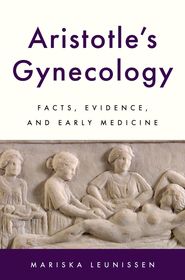
Aristotle's Gynecology
Facts, Evidence, and Early Medicine
- Publisher's listprice GBP 59.00
-
26 638 Ft (25 370 Ft + 5% VAT)
The price is estimated because at the time of ordering we do not know what conversion rates will apply to HUF / product currency when the book arrives. In case HUF is weaker, the price increases slightly, in case HUF is stronger, the price goes lower slightly.
- Discount 10% (cc. 2 663 Ft off)
- Discounted price 23 975 Ft (22 833 Ft + 5% VAT)
Subcribe now and take benefit of a favourable price.
Subscribe
26 638 Ft

Availability
Estimated delivery time: In stock at the publisher, but not at Prospero's office. Delivery time approx. 3-5 weeks.
Not in stock at Prospero.
Why don't you give exact delivery time?
Delivery time is estimated on our previous experiences. We give estimations only, because we order from outside Hungary, and the delivery time mainly depends on how quickly the publisher supplies the book. Faster or slower deliveries both happen, but we do our best to supply as quickly as possible.
Product details:
- Publisher OUP USA
- Date of Publication 12 August 2025
- ISBN 9780197790397
- Binding Hardback
- No. of pages320 pages
- Size 229x160x27 mm
- Weight 590 g
- Language English 612
Categories
Short description:
Facts, Evidence, and Early Medicine in Aristotle's Gynecology discusses Aristotle's methods for the establishment of gynecological facts within his natural science, arguing that many of the gynecological phenomena at stake, such as menstruation and the nature of menstrual blood, the role of female pleasure during sex and women's experiences of erotic dreams, and their knowledge of conception and their experiences of (false) pregnancy and childbirth, were-mostly for socio-cultural reasons-not at all or not immediately accessible for a male natural scientific observer such as Aristotle.
MoreLong description:
In Aristotle's Gynecology, Mariska Leunissen examines Aristotle's methods for the establishment of gynecological facts within his natural science, arguing that many of the gynecological phenomena at stake, such as menstruation and the nature of menstrual blood, the role of female pleasure during sex and women's experiences of erotic dreams, and their knowledge of conception and their experiences of (false) pregnancy and childbirth, were-mostly for socio-cultural reasons-not at all or not immediately accessible for a male natural scientific observer such as Aristotle.
Given this lack of immediate empirical evidence, Aristotle employed alternative methods for the establishment of facts-such as relying on signs and circumstantial empirical evidence or using analogical and probabilistic reasoning-and relied heavily on existing expert reports, such as mainly early medical sources but also sometimes verbal reports from women themselves. Moreover, Aristotle used a “secondary standard” for testing the results of this inquiry, namely one which he originally developed for investigations into physically remote meteorological and cosmological phenomena that are “not apparent to observation,” and according to which statements of facts are credible if they are ontologically possible.
Leunissen thus reconstructs “Aristotle's gynecology” in the context of his commitments to empiricism and his scientific methods for the fact-establishing phase of natural science, and elucidates the role his concepts of evidence, credibility, and signs play in his natural scientific research. However, through its focus on Aristotle's use of gendered knowledge and his reconstruction of natural phenomena believed to be characteristic of women, Leunissen's book also offers a glimpse of the lived experiences and reproductive beliefs of women in Ancient Greece.
Table of Contents:
Aristotle's Two Standards for Natural Scientific Inquiry
The Facts about Menses and the Female Contribution to Generation
The Menses in the Mirror
The Facts about Pleasure during Sex and Conception
The Winds in the Womb
The Facts about Pregnancy and Childbirth
Conclusion

