

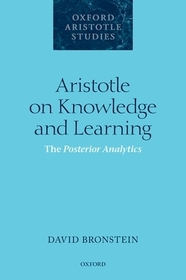
Aristotle on Knowledge and Learning
The Posterior Analytics
Series: Oxford Aristotle Studies Series;
- Publisher's listprice GBP 88.00
-
39 732 Ft (37 840 Ft + 5% VAT)
The price is estimated because at the time of ordering we do not know what conversion rates will apply to HUF / product currency when the book arrives. In case HUF is weaker, the price increases slightly, in case HUF is stronger, the price goes lower slightly.
- Discount 10% (cc. 3 973 Ft off)
- Discounted price 35 759 Ft (34 056 Ft + 5% VAT)
Subcribe now and take benefit of a favourable price.
Subscribe
39 732 Ft

Availability
printed on demand
Why don't you give exact delivery time?
Delivery time is estimated on our previous experiences. We give estimations only, because we order from outside Hungary, and the delivery time mainly depends on how quickly the publisher supplies the book. Faster or slower deliveries both happen, but we do our best to supply as quickly as possible.
Product details:
- Publisher OUP Oxford
- Date of Publication 24 March 2016
- ISBN 9780198724902
- Binding Hardback
- No. of pages288 pages
- Size 240x162x20 mm
- Weight 560 g
- Language English 0
Categories
Short description:
David Bronstein sheds new light on Aristotle's Posterior Analytics, one of the most important, and difficult, works in the history of western philosophy. He argues that it is coherently structured around two themes of enduring philosophical interest--knowledge and learning--and goes on to highlight Plato's influence on Aristotle's text.
MoreLong description:
'All teaching and all intellectual learning come to be from pre-existing knowledge.' So begins Aristotle's Posterior Analytics, one of the most important, and difficult, works in the history of western philosophy. David Bronstein sheds new light on this challenging text by arguing that it is coherently structured around two themes of enduring philosophical interest: knowledge and learning.
The Posterior Analytics, on Bronstein's reading, is a sustained examination of scientific knowledge: what it is and how it is acquired. Aristotle first discusses two principal forms of scientific knowledge (epist?m? and nous). He then provides a compelling account, in reverse order, of the types of learning one needs to undertake in order to acquire them. The Posterior Analytics thus emerges as an elegantly organized work in which Aristotle describes the mind's ascent from sense-perception of particulars to scientific knowledge of first principles.
Bronstein also highlights Plato's influence on Aristotle's text. For each type of learning Aristotle discusses, Bronstein uncovers an instance of Meno's Paradox (a puzzle from Plato's Meno according to which inquiry and learning are impossible) and a solution to it. In addition, he argues, against current orthodoxy, that Aristotle is committed to the Socratic Picture of inquiry, according to which one should seek what a thing's essence is before seeking its demonstrable attributes and their causes.
Aristotle on Knowledge and Learning will be of interest to students and scholars of ancient philosophy, epistemology, or philosophy of science.
Aristotle on Knowledge and Learning is a solid achievement. It offers a host of insights into problematic concepts and passages that merit further debate, and a plausible overall account of the work's internal dynamics. For both these reasons, Bronstein's book should become a departure point for future explorations of Aristotle's ever fascinating account of scientific knowledge and its acquisition.
Table of Contents:
Introduction
General Introduction
Meno's Paradox and the Prior Knowledge Requirement
Part I: Learning by Demonstration
Learning by Demonstration
Belonging 'In Itself' and Aristotle's Theory of Demonstration
Scientific Knowledge and Demonstration
Part II: Learning by Definition
Learning by Definition: Introduction
Inquiry in APo 2.1
Inquiry in APo 2.2
The Socratic Picture of the Order of Inquiry
Cause, Essence, and Definition
Discovering Causally Complex Essences: APo 2.8
Subject-Kinds and their Existence
Discovering Causally Simple Essences: APo 2.13
Part III: Learning by Induction
The Origin and Aim of APo 2.19
Conclusion
Bibliography
Index

