

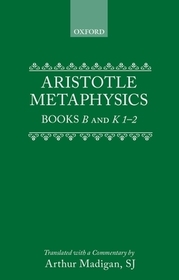
Aristotle: Metaphysics Books B and K 1-2
Series: Clarendon Aristotle Series;
- Publisher's listprice GBP 142.50
-
64 338 Ft (61 275 Ft + 5% VAT)
The price is estimated because at the time of ordering we do not know what conversion rates will apply to HUF / product currency when the book arrives. In case HUF is weaker, the price increases slightly, in case HUF is stronger, the price goes lower slightly.
- Discount 10% (cc. 6 433 Ft off)
- Discounted price 57 905 Ft (55 148 Ft + 5% VAT)
Subcribe now and take benefit of a favourable price.
Subscribe
64 338 Ft

Availability
printed on demand
Why don't you give exact delivery time?
Delivery time is estimated on our previous experiences. We give estimations only, because we order from outside Hungary, and the delivery time mainly depends on how quickly the publisher supplies the book. Faster or slower deliveries both happen, but we do our best to supply as quickly as possible.
Product details:
- Publisher OUP Oxford
- Date of Publication 25 November 1999
- ISBN 9780198751052
- Binding Hardback
- No. of pages226 pages
- Size 224x146x18 mm
- Weight 391 g
- Language English 0
Categories
Short description:
Arthur Madigan presents a clear, accurate new translation of the third book (Beta) of Aristotle's Metaphysics, together with two related chapters from the eleventh book (Kappa). Madigan's accompanying introduction and commentary give detailed guidance to these texts, in which Aristotle sets out the main questions of metaphysics and assesses the main answers to them, and which serve as a useful introduction not just to Aristotle's own work on metaphysics but to classical metaphysics in general.
MoreLong description:
Arthur Madigan presents a clear, accurate new translation of the third book (Beta) of Aristotle's Metaphysics, together with two related chapters from the eleventh book (Kappa). Madigan's accompanying introduction and commentary give detailed guidance to these texts, in which Aristotle sets out what he takes to be the main problems of metaphysics or 'first philosophy' and assesses possible solutions to them; he takes his starting-point from the work of earlier philosophers, especially Plato and some of the Presocratics. These texts serve as a useful introduction both to Aristotle's own work on metaphysics and to classical metaphysics in general; they are also a good example of Aristotle's dialectical method, which reasons not from known truths but from reputable opinions.
MoreTable of Contents:
Introduction; Translation; Commentary; Notes on the Text and Translation; Bibliography; Glossaries; Indexes.
More
