

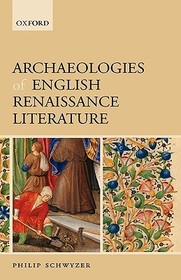
Archaeologies of English Renaissance Literature
- Publisher's listprice GBP 67.00
-
30 250 Ft (28 810 Ft + 5% VAT)
The price is estimated because at the time of ordering we do not know what conversion rates will apply to HUF / product currency when the book arrives. In case HUF is weaker, the price increases slightly, in case HUF is stronger, the price goes lower slightly.
- Discount 10% (cc. 3 025 Ft off)
- Discounted price 27 225 Ft (25 929 Ft + 5% VAT)
Subcribe now and take benefit of a favourable price.
Subscribe
30 250 Ft

Availability
printed on demand
Why don't you give exact delivery time?
Delivery time is estimated on our previous experiences. We give estimations only, because we order from outside Hungary, and the delivery time mainly depends on how quickly the publisher supplies the book. Faster or slower deliveries both happen, but we do our best to supply as quickly as possible.
Product details:
- Publisher OUP Oxford
- Date of Publication 22 February 2007
- ISBN 9780199206605
- Binding Hardback
- No. of pages240 pages
- Size 222x144x19 mm
- Weight 406 g
- Language English
- Illustrations 11 black and white illustrations 0
Categories
Short description:
Early modern English literature abounds with archaeological images, from open graves to ruined monasteries. Schwyzer demonstrates that archaeology can shed light on literary texts including works by Spenser, Shakespeare, and Donne. The book also explores the kinship between two disciplines distinguished by their intimacy with the traces of past life.
MoreLong description:
This study draws on the theory and practice of archaeology to develop a new perspective on the literature of the Renaissance. Philip Schwyzer explores the fascination with images of excavation, exhumation, and ruin that runs through literary texts including Spenser's Faerie Queene, Shakespeare's Romeo and Juliet and Hamlet, Donne's sermons and lyrics, and Thomas Browne's Hydriotaphia, or Urne-Buriall. Miraculously preserved corpses, ruined monasteries, Egyptian mummies, and Yorick's skull all figure in this study of the early modern archaeological imagination. The pessimism of the period is summed up in the haunting motif of the beautiful corpse that, once touched, crumbles to dust.
Archaeology and literary studies are themselves products of the Renaissance. Although the two disciplines have sometimes viewed one another as rivals, they share a unique and unsettling intimacy with the traces of past life - with the words the dead wrote, sang, or heard, with the objects they made, held, or lived within. Schwyzer argues that at the root of both forms of scholarship lies the forbidden desire to awaken (and speak with) the dead. However impossible or absurd this desire may be, it remains a fundamental source of both ethical responsibility and aesthetic pleasure.
accessible but provocative and never less than compelling.
Table of Contents:
Introduction
Intimate Disciplines: Archaeology, Literary Criticism, and the Traces of the Dead
Exhumation and Ethnic Conflict: Colonial Archaeology From St. Erkenwald to Spenser in Ireland
Dissolving Images: Monastic Ruins in Elizabethan Poetry
Charnel Knowledge: Open Graves in Shakespeare and Donne
'Mummy Is Become Merchandise': Cannibals and Commodities in the Seventeenth Century
Readers of the Lost Urns: Desire and Disintegration in Thomas Browne's Urn-Burial

