

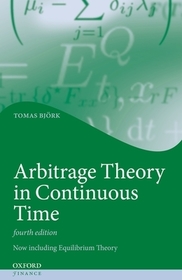
Arbitrage Theory in Continuous Time
Series: Oxford Finance Series;
- Publisher's listprice GBP 67.00
-
30 250 Ft (28 810 Ft + 5% VAT)
The price is estimated because at the time of ordering we do not know what conversion rates will apply to HUF / product currency when the book arrives. In case HUF is weaker, the price increases slightly, in case HUF is stronger, the price goes lower slightly.
- Discount 10% (cc. 3 025 Ft off)
- Discounted price 27 225 Ft (25 929 Ft + 5% VAT)
Subcribe now and take benefit of a favourable price.
Subscribe
30 250 Ft

Availability
Estimated delivery time: In stock at the publisher, but not at Prospero's office. Delivery time approx. 3-5 weeks.
Not in stock at Prospero.
Why don't you give exact delivery time?
Delivery time is estimated on our previous experiences. We give estimations only, because we order from outside Hungary, and the delivery time mainly depends on how quickly the publisher supplies the book. Faster or slower deliveries both happen, but we do our best to supply as quickly as possible.
Product details:
- Edition number 4
- Publisher OUP Oxford
- Date of Publication 18 December 2019
- ISBN 9780198851615
- Binding Hardback
- No. of pages592 pages
- Size 241x162x36 mm
- Weight 1019 g
- Language English 0
Categories
Short description:
The fourth edition of this widely used textbook on pricing and hedging of financial derivatives now also includes dynamic equilibrium theory and continues to combine sound mathematical principles with economic applications.
MoreLong description:
The fourth edition of this widely used textbook on pricing and hedging of financial derivatives now also includes dynamic equilibrium theory and continues to combine sound mathematical principles with economic applications.
Concentrating on the probabilistic theory of continuous time arbitrage pricing of financial derivatives, including stochastic optimal control theory and optimal stopping theory, Arbitrage Theory in Continuous Time is designed for graduate students in economics and mathematics, and combines the necessary mathematical background with a solid economic focus. It includes a solved example for every new technique presented, contains numerous exercises, and suggests further reading in each chapter. All concepts and ideas are discussed, not only from a mathematics point of view, but with lots of intuitive economic arguments.
In the substantially extended fourth edition Tomas Björk has added completely new chapters on incomplete markets, treating such topics as the Esscher transform, the minimal martingale measure, f-divergences, optimal investment theory for incomplete markets, and good deal bounds. This edition includes an entirely new section presenting dynamic equilibrium theory, covering unit net supply endowments models and the Cox-Ingersoll-Ross equilibrium factor model.
Providing two full treatments of arbitrage theory-the classical delta hedging approach and the modern martingale approach-this book is written so that these approaches can be studied independently of each other, thus providing the less mathematically-oriented reader with a self-contained introduction to arbitrage theory and equilibrium theory, while at the same time allowing the more advanced student to see the full theory in action.
This textbook is a natural choice for graduate students and advanced undergraduates studying finance and an invaluable introduction to mathematical finance for mathematicians and professionals in the market.
Review from previous edition This book is one of the best of a large number of new books on mathematical and probabilistic models in finance, positioned between the books by Hull and Duffie on a mathematical scale...This is a highly reasonable book and strikes a balance between mathematical development and intuitive explanation.
Table of Contents:
Introduction
I. Discrete Time Models
The Binomial Model
A More General One period Model
II. Stochastic Calculus
Stochastic Integrals
Stochastic Differential Equations
III. Arbitrage Theory
Portfolio Dynamics
Arbitrage Pricing
Completeness and Hedging
A Primer on Incomplete Markets
Parity Relations and Delta Hedging
The Martingale Approach to Arbitrage Theory
The Mathematics of the Martingale Approach
Black-Scholes from a Martingale Point of View
Multidimensional Models: Martingale Approach
Change of Numeraire
Dividends
Forward and Futures Contracts
Currency Derivatives
Bonds and Interest Rates
Short Rate Models
Martingale Models for the Short Rate
Forward Rate Models
LIBOR Market Models
Potentials and Positive Interest
IV. Optimal Control and Investment Theory
Stochastic Optimal Control
Optimal Consumption and Investment
The Martingale Approach to Optimal Investment
Optimal Stopping Theory and American Options
V. Incomplete Markets
Incomplete Markets
The Esscher Transform and the Minimal Martingale Measure
Minimizing f-divergence
Portfolio Optimization in Incomplete Markets
Utility Indifference Pricing and Other Topics
Good Deal Bounds
VI. Dynamic Equilibrium Theory
Equilibrium Theory: A Simple Production Model
The Cox-Ingersoll-Ross Factor Model
The Cox-Ingersoll-Ross Interest Rate Model
Endowment Equilibrium: Unit Net Supply

