

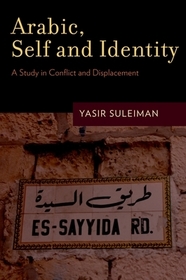
Arabic, Self and Identity
A Study in Conflict and Displacement
- Publisher's listprice GBP 54.00
-
24 381 Ft (23 220 Ft + 5% VAT)
The price is estimated because at the time of ordering we do not know what conversion rates will apply to HUF / product currency when the book arrives. In case HUF is weaker, the price increases slightly, in case HUF is stronger, the price goes lower slightly.
- Discount 10% (cc. 2 438 Ft off)
- Discounted price 21 943 Ft (20 898 Ft + 5% VAT)
Subcribe now and take benefit of a favourable price.
Subscribe
24 381 Ft

Availability
printed on demand
Why don't you give exact delivery time?
Delivery time is estimated on our previous experiences. We give estimations only, because we order from outside Hungary, and the delivery time mainly depends on how quickly the publisher supplies the book. Faster or slower deliveries both happen, but we do our best to supply as quickly as possible.
Product details:
- Publisher OUP USA
- Date of Publication 17 November 2011
- ISBN 9780199747009
- Binding Paperback
- No. of pages288 pages
- Size 229x152x16 mm
- Weight 426 g
- Language English
- Illustrations 22 illus. 0
Categories
Short description:
Arabic, Self, and Identity uses autoethnography, autobiography, and a detailed study of names to investigate the links between conflict and displacement, and between the Self and group identity.
MoreLong description:
Arabic, Self, and Identity uses autoethnography, autobiography, and a detailed study of names to investigate the links between conflict and displacement, and between the Self and group identity. In the process it raises questions about trauma and globalization, underscoring the complex roles of language and identity in society.
Yasir Suleiman frames his findings against a far-reaching critique of the dominant, correlational approach in Arabic sociolinguitics. He argues that this approach does not sufficiently explore the link between language and the major narratives of identity and conflict in the Middle East. Instead he advocates for combining this approach with qualitative studies that are nevertheless aware of the limits of interpretation and the positionality of the researcher. This combined endeavor, Suleiman says, can generate a richer understanding of the sociopolitical underpinnings of language, and help to bridge the gaps between the various disciplines that converge on language as a field of investigation and analysis.
The book is rich, informative, and interesting at the thematic, methodological, and informational levels. The book is a valuable resource for different groups of readers, including sociolinguists, historians, anthropologists, politicians, as well as non-professionals.
Table of Contents:
Introduction
Seven Fault Zones and Beyond: Some Methodological Considerations
Arabic, Self and Autoethnography
Arabic, Self and Displacement
Names, Identity and Conflict
Conclusion
Bibliography
Index

