

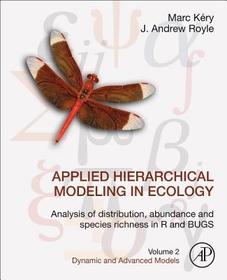
Applied Hierarchical Modeling in Ecology: Analysis of Distribution, Abundance and Species Richness in R and BUGS
Volume 2: Dynamic and Advanced Models
- Publisher's listprice EUR 92.95
-
38 551 Ft (36 715 Ft + 5% VAT)
The price is estimated because at the time of ordering we do not know what conversion rates will apply to HUF / product currency when the book arrives. In case HUF is weaker, the price increases slightly, in case HUF is stronger, the price goes lower slightly.
- Discount 10% (cc. 3 855 Ft off)
- Discounted price 34 696 Ft (33 044 Ft + 5% VAT)
Subcribe now and take benefit of a favourable price.
Subscribe
38 551 Ft

Availability
cancelled
Why don't you give exact delivery time?
Delivery time is estimated on our previous experiences. We give estimations only, because we order from outside Hungary, and the delivery time mainly depends on how quickly the publisher supplies the book. Faster or slower deliveries both happen, but we do our best to supply as quickly as possible.
Product details:
- Publisher Elsevier Science
- Date of Publication 19 October 2020
- ISBN 9780128095850
- Binding Paperback
- No. of pages820 pages
- Size 234x190 mm
- Weight 450 g
- Language English 0
Categories
Long description:
Applied Hierarchical Modeling in Ecology: Analysis of Distribution, Abundance and Species Richness in R and BUGS, Volume Two: Dynamic and Advanced Models provides a synthesis of the state-of-the-art in hierarchical models for plant and animal distribution, also focusing on the complex and more advanced models currently available. The book explains all procedures in the context of hierarchical models that represent a unified approach to ecological research, thus taking the reader from design, through data collection, and into analyses using a very powerful way of synthesizing data.
MoreTable of Contents:
PART 1 MODELS FOR DYNAMIC SYSTEMS1. Relative Abundance Models for Population Dynamics2. Modeling Population Dynamics With Count Data3. Hierarchical Models of Survival4. Modeling Species Distribution and Range Dynamics, and Population Dynamics Using Dynamic Occupancy Models5. Modeling Metacommunity Dynamics Using Dynamic Community Models
PART 2 ADVANCED MODELS6. Multi-state Occupancy Models7. Modeling False Positives8. Modeling Interactions Among Species9. Spatial Models of Distribution and Abundance10. Integrated Models for Multiple Types of Data11. Spatially Explicit Distance Sampling Along Transects12. Conclusions
More
