

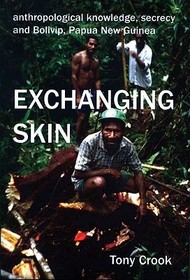
Anthropological Knowledge, Secrecy and Bolivip, Papua New Guinea
Exchanging Skin
Series: British Academy Monographs;
- Publisher's listprice GBP 60.00
-
27 090 Ft (25 800 Ft + 5% VAT)
The price is estimated because at the time of ordering we do not know what conversion rates will apply to HUF / product currency when the book arrives. In case HUF is weaker, the price increases slightly, in case HUF is stronger, the price goes lower slightly.
- Discount 10% (cc. 2 709 Ft off)
- Discounted price 24 381 Ft (23 220 Ft + 5% VAT)
Subcribe now and take benefit of a favourable price.
Subscribe
27 090 Ft

Availability
Estimated delivery time: In stock at the publisher, but not at Prospero's office. Delivery time approx. 3-5 weeks.
Not in stock at Prospero.
Why don't you give exact delivery time?
Delivery time is estimated on our previous experiences. We give estimations only, because we order from outside Hungary, and the delivery time mainly depends on how quickly the publisher supplies the book. Faster or slower deliveries both happen, but we do our best to supply as quickly as possible.
Product details:
- Publisher OUP Oxford
- Date of Publication 6 September 2007
- ISBN 9780197264003
- Binding Hardback
- No. of pages276 pages
- Size 240x160x25 mm
- Weight 715 g
- Language English
- Illustrations 20 halftones 0
Categories
Short description:
This study of one of the most enigmatic cultures in the world looks at the nature of knowledge in the Min area of Papua New Guinea (where sharing knowledge is believed to be like exchanging skin), and uses these understandings to consider our own anthropological notions of knowledge.
MoreLong description:
What is the nature of knowledge? Anthropology imagines it possible to divide or separate social and analytical relations, whereby knowledge travels between persons as a thing. And yet, Bolivip imagines knowledge as the bodily resources or parts of a person that can be extended or combined with others. This methodological exchange is modelled on a moment from Bolivip - an exchange of skin whereby knowledge is returned in respect of prior nurture and care given, and two people become encompassed by one skin.
The Min area of Papua New Guinea has proven to be one of the most enigmatic cultures in anthropological experience. But rather than accept this resistance to analysis as a problem of Melanesian secrecy, this volume suggests that archaic notions of anthropological knowledge have been the problem all along. Taking up the 'Min problem' head on, this study suggests a novel solution to the impasse.
The argument works through alternating chapters: an imagistic ethnography of Bolivip describes how arboreal and horticultural metaphors motivate the growth of persons and plants by circulating bodily resources through others. Knowledge here comes from those who contribute to conception, and is withheld until a person is capable of bearing it. These images are used to provide new readings of classic Melanesianist texts - Mead, Bateson and Fortune - substituting theoretical ideas for intimate relations; Weiner and Strathern's own experiments with anthropology modelled on Melanesia; and Barth's reading of secrecy amongst the Min.
The book provides an valuable insight into our own assumptions about knowledge and the world by means of insights into the aesthetics of a Papua New Guinean lifeworld.

