

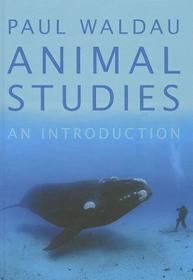
Animal Studies
An Introduction
- Publisher's listprice GBP 120.00
-
54 180 Ft (51 600 Ft + 5% VAT)
The price is estimated because at the time of ordering we do not know what conversion rates will apply to HUF / product currency when the book arrives. In case HUF is weaker, the price increases slightly, in case HUF is stronger, the price goes lower slightly.
- Discount 10% (cc. 5 418 Ft off)
- Discounted price 48 762 Ft (46 440 Ft + 5% VAT)
Subcribe now and take benefit of a favourable price.
Subscribe
54 180 Ft

Availability
printed on demand
Why don't you give exact delivery time?
Delivery time is estimated on our previous experiences. We give estimations only, because we order from outside Hungary, and the delivery time mainly depends on how quickly the publisher supplies the book. Faster or slower deliveries both happen, but we do our best to supply as quickly as possible.
Product details:
- Publisher OUP USA
- Date of Publication 28 March 2013
- ISBN 9780199827015
- Binding Hardback
- No. of pages384 pages
- Size 183x257x30 mm
- Weight 967 g
- Language English 0
Categories
Short description:
Animal studies is a growing interdisciplinary field which seeks to understand how humans study and conceive of other-than-human animals, and how these conceptions have changed over time, across cultures, and among various scholarly modes of inquiry. Until now, this growing field has lacked a comprehensive introductory text appropriate for new scholars. Animal Studies: An Introduction fills this deficiency, providing the first holistic survey of the field.
MoreLong description:
Human culture values some nonhumans but not others, while human culture as a whole is engaged with an incredibly diverse range of living beings.
Animal studies is a growing interdisciplinary field that incorporates scholarship from public policy, sociology, religion, politics, philosophy, and many other fields. In essence, it seeks to understand how humans study and conceive of other-than-human animals, and how these conceptions have changed over time, across cultures, and among various scholarly modes of inquiry. This interdisciplinary introduction to the field boldly and creatively foregrounds the realities of nonhuman animals, as well as the imaginative and ethical faculties that humans must engage to consider our intersection with living beings outside of our species.
The field requires both learning and unlearning to develop forms of critical thinking that are scientifically informed and ethically sensitive. This book is a frank assessment of the ways human-centered approaches undermine the core values of the scientific tradition, robust education, and human compassion. Further, it argues that the breadth and depth of thinking and the humility needed to grasp the human-nonhuman intersection has the potential to expand the dualism that currently divides the sciences and humanities.
As the first holistic survey of the field, Animal Studies is essential reading for any student of human-animal relationships, and for all people who care about the role nonhuman animals play in our society.
Paul Waldau's book will help to define the emerging field of animal studies. To draw together and summarize such diverse work from many different disciplines is a considerable achievement in itself. But Animal Studies does much more than that, for the reader will benefit from Waldau's well-grounded assessment of the strengths and weaknesses of the writers and disciplines he discusses.
Table of Contents:
Introduction
Chapter 1. Opening Doors: Four General Issues, Four Basic Tasks
Chapter 2. Through Open Doors: The Challenges of History, Culture and Education
Chapter 3. Science, Politics and Other Animals
Chapter 4. Early Twenty-First Century Animal Studies: Three Cutting Edges
Chapter 5. Animals in the Creative Arts
Chapter 6. Animals in Philosophy
Chapter 7. Comparative Studies: Legal Systems, Religions and Cultures
Chapter 8. Animals and Modern Social Realities
Chapter 9. The Special Roles of Anthropology, Archeology and Geography
Chapter 10. Telling the Larger Story
Chapter 11. Marginalized Humans and Other Animals
Chapter 12. The Question of Leadership: Getting Beyond Pioneers and Leaders to Individual Choices
Chapter 13. The Future of Animal Studies
Conclusion

