

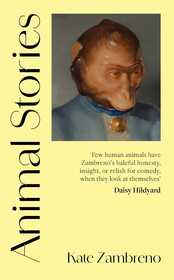
Animal Stories
-
GET 20% OFF
- Publisher's listprice GBP 12.99
-
6 205 Ft (5 910 Ft + 5% VAT)
The price is estimated because at the time of ordering we do not know what conversion rates will apply to HUF / product currency when the book arrives. In case HUF is weaker, the price increases slightly, in case HUF is stronger, the price goes lower slightly.
- Discount 20% (cc. 1 241 Ft off)
- Discounted price 4 964 Ft (4 728 Ft + 5% VAT)
- Discount is valid until: 31 March 2026
4 964 Ft

Availability
Not yet published.
Why don't you give exact delivery time?
Delivery time is estimated on our previous experiences. We give estimations only, because we order from outside Hungary, and the delivery time mainly depends on how quickly the publisher supplies the book. Faster or slower deliveries both happen, but we do our best to supply as quickly as possible.
Product details:
- Publisher Scribner UK
- Date of Publication 9 April 2026
- Number of Volumes Paperback - Trade paperback (UK)
- ISBN 9781398556232
- Binding Paperback
- No. of pages192 pages
- Size 5486x3429x13 mm
- Language English 700
Categories
Short description:
A curious exploration of mortality, alienation, boredom, surveillance and how we regard ourselves among the animals.
Animal Stories&&&160;begins with Kate Zambreno’s visit to the monkey house at the Jardin des Plantes in Paris, where one stark tree ‘seems to be the stage design for a simian production of Waiting for Godot’. But who are the players and who is the audience, and can they recognise each other?
What follows is a series of reports from the deep strangeness of the zoo, a space that is ‘more often than not deeply sad, an odd choice for regular pilgrimages of fun’. Amid these excursions with their young children, Zambreno turns to Garry Winogrand’s photographs and John Berger’s writings on animals, reshaping the spectator as the subject to decipher our complex ‘zoo feelings’ – what we project, and what we refuse to see. In ‘My Kafka System’, which dovetails with these zoo studies, Zambreno thinks through the notebooks and animal stories of a writer known for playing at the threshold between species, continuing their investigation into the false divide between human and animal.
In writing that is inquisitive and inventive, Zambreno renders visible the enclosures we construct and those we occupy ourselves.
MoreLong description:
A curious exploration of mortality, alienation, boredom, surveillance and how we regard ourselves among the animals.
‘Few human animals have Zambreno’s baleful honesty, insight, or relish for comedy, when they look at themselves’ Daisy Hildyard, author of&&&160;Hunters in the Snow&&&160;and&&&160;Emergency
Animal Stories&&&160;begins with Kate Zambreno’s visit to the monkey house at the Jardin des Plantes in Paris, where one stark tree ‘seems to be the stage design for a simian production of Waiting for Godot’. But who are the players and who is the audience, and can they recognise each other?
What follows is a series of reports from the deep strangeness of the zoo, a space that is ‘more often than not deeply sad, an odd choice for regular pilgrimages of fun’. Amid these excursions with their young children, Zambreno turns to Garry Winogrand’s photographs and John Berger’s writings on animals, reshaping the spectator as the subject to decipher our complex ‘zoo feelings’ – what we project, and what we refuse to see. In ‘My Kafka System’, which dovetails with these zoo studies, Zambreno thinks through the notebooks and animal stories of a writer known for playing at the threshold between species, continuing their investigation into the false divide between human and animal.
In writing that is inquisitive and inventive, Zambreno renders visible the enclosures we construct and those we occupy ourselves.
Praise for Animal Stories:
‘I loved the precision of Kate Zambreno’s Animal Stories – a literal attention so heightened that it becomes distinct and peculiar. Are we looking at seal or a walrus? Which zoo is in the background of the photograph? At what time of day was Kafka sitting in the Paris cafe, and how many yoghurts did he eat there? This attention made me trust these stories. Few human animals have Zambreno’s baleful honesty, insight, or relish for comedy, when they look at themselves’ Daisy Hildyard, author of Hunters in the Snow and Emergency
&&&39;Zambreno&&&39;s lucid writing and relentless inquisitiveness shine.&&&39; Publishers Weekly
&&&39;Lyrical meditations on the creative imagination and the animal in all of us...[Animal Stories] is a tour of the zoo cages of the writer’s own mind, opened for all of us to gaze on and gasp.&&&39; Kirkus Reviews
&&&39;A searching, charmingly discursive meditation...Zambreno’s reveries flit between criticism, history, and memoir—an approach well-suited to the diffuse melancholy of the zoo.&&&39; Dan Piepenbring, Harper’s
&&&39;A personal, historical, and philosophical reflection on the gap between human and animal perceptions of each other…[Animal Stories] considers the tragicomic implications of our own animal being&&&39; Brian Dillon, 4Columns
&&&39;A view on the world using a deep field of focus that renders details near and far with equal clarity. Ostensibly unrelated figures are thus united within the writer’s rich conceptual frame...Blazingly erudite...Animal Stories reflects [Zambreno’s] vital unboundedness.&&&39; The Brooklyn Rail
&&&39;Zambreno is one of our most inventive and formally daring writers…[Animal Stories] sees them at the height of their powers.&&&39; The Millions
&&&39;Zambreno, a brilliant feminist author whose insights have recontextualized generations of writings by women, visits the monkey house at a Parisian zoo. This window into simian behavior offers Zambreno some astonishing new insights into the whole of human behavior—including how we consider ourselves in relation to other animals.&&&39; The Seattle Times
Praise for Kate Zambreno:
&&&39;Kate Zambreno has invented a new form. It is a kind of absolute present, real life captured in closeup.&&&39; Annie Ernaux, winner of the Nobel Prize in Literature
‘Zambreno’s oeuvre is not just a series of books but a body of thought, an uninterrupted exhortation on incompleteness and the intersections of life, death, time, memory, and silence’ Sarah Manguso, The Paris Review
More

