

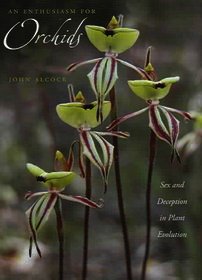
An Enthusiasm for Orchids
Sex and Deception in Plant Evolution
- Publisher's listprice GBP 46.99
-
22 449 Ft (21 380 Ft + 5% VAT)
The price is estimated because at the time of ordering we do not know what conversion rates will apply to HUF / product currency when the book arrives. In case HUF is weaker, the price increases slightly, in case HUF is stronger, the price goes lower slightly.
- Discount 10% (cc. 2 245 Ft off)
- Discounted price 20 204 Ft (19 242 Ft + 5% VAT)
Subcribe now and take benefit of a favourable price.
Subscribe
22 449 Ft

Availability
printed on demand
Why don't you give exact delivery time?
Delivery time is estimated on our previous experiences. We give estimations only, because we order from outside Hungary, and the delivery time mainly depends on how quickly the publisher supplies the book. Faster or slower deliveries both happen, but we do our best to supply as quickly as possible.
Product details:
- Publisher OUP USA
- Date of Publication 5 January 2006
- ISBN 9780195182743
- Binding Hardback
- No. of pages320 pages
- Size 157x235x25 mm
- Weight 734 g
- Language English
- Illustrations Numerous colour photographs, line drawings 0
Categories
Short description:
What constitutes an adaptation, how do complex adaptations come into being, and where do species with their special attributes come from? Alcock explores these questions, explaining why some biologists think they know what adaptations are and how they arise and what species are. Orchids have especially intricate relationships with their pollinators, which raises questions about the nature of adaptations of this sort. Orchids also comprise the largest plant family of them all, perhaps as many as 30,000 species, which naturally provokes curiousity about the processes responsible for this exuberant proliferation of species. Orchids provide a rich source of material for an analysis of both adaptation and speciation. Many have the advantage of being clearly spectacular plants, inspiring enthusiasm, even passion, making them an especially appealing object of scrutiny.
MoreLong description:
The male thynnine wasp's extreme sexual enthusiasm is crucial to reproduction of hammer orchids in the wild. Hammer orchids have co-evolved to produce odors identical to those manufactured by female thynnine wasps. The male wasp's superb sensitivity to the scent of his female mate is the basis for the hammer orchid's deceit--in effect, orchids exploit the male insect's highly adaptive sense of smell for their own propogation. While pollinating orchids is a waste of time, and thus a maladaptive activity for a wasp, his mistake comes about because he must react quickly whenever he senses a possible mate nearby. Alcock suggests that, "for insects, he who hesitates is lost, although perhaps it would be better to say that he who hesitates often loses a chance to pass on his genes."
This book abounds with clever explanations for how these exceptionally complex flowers came to be shaped as they are. The reader can explore many aspects of orchid biology and history ranging from how some species avoid inbreeding, to the origins of orchids from an ancestor that belonged to the asparagus family. Examining each component of an orchid's flower, Alcock explains how the various parts work together to produce the plant's minute offspring. Each element of an orchid, as quirky as it may seem, is biologically significant, bearing the imprint of natural selection. Readers can share in the delight that Darwin and all other orchid enthusiasts have felt in making sense of even the smallest of details of these most wonderful plants.
An Enthusiasm for Orchids: Sex and Deception in Plant Evolution is ... an interesting book, [that] can provide good examples of plant adaptations which are desperately needed in these sort of classrooms which tend to focus more often on animal examples.

