

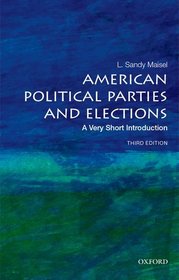
American Political Parties and Elections
A Very Short Introduction
Series: Very Short Introductions;
- Publisher's listprice GBP 9.99
-
4 510 Ft (4 295 Ft + 5% VAT)
The price is estimated because at the time of ordering we do not know what conversion rates will apply to HUF / product currency when the book arrives. In case HUF is weaker, the price increases slightly, in case HUF is stronger, the price goes lower slightly.
- Discount 20% (cc. 902 Ft off)
- Discounted price 3 608 Ft (3 436 Ft + 5% VAT)
- Discount is valid until: 30 June 2026
Subcribe now and take benefit of a favourable price.
Subscribe
4 510 Ft

Availability
Estimated delivery time: In stock at the publisher, but not at Prospero's office. Delivery time approx. 3-5 weeks.
Not in stock at Prospero.
Why don't you give exact delivery time?
Delivery time is estimated on our previous experiences. We give estimations only, because we order from outside Hungary, and the delivery time mainly depends on how quickly the publisher supplies the book. Faster or slower deliveries both happen, but we do our best to supply as quickly as possible.
Product details:
- Edition number 3
- Publisher OUP USA
- Date of Publication 24 November 2022
- ISBN 9780197605110
- Binding Paperback
- No. of pages224 pages
- Size 173x113x13 mm
- Weight 181 g
- Language English
- Illustrations 10 halftones 257
Categories
Short description:
Few Americans and even fewer citizens of other nations understand the electoral process in the United States. The third edition of this Very Short Introduction offers an up-to-date overview of American political parties and elections, providing an expert view of how the system actually works while shining a light on some of its flaws.
MoreLong description:
Few Americans and even fewer citizens of other nations understand the electoral process in the United States. Still fewer understand the role played by political parties in the electoral process or the ironies within the system. Participation in elections in the United States is much lower than in the vast majority of mature democracies. Perhaps this is because of the lack of competition in a country where only two parties have a true chance of winning, despite the fact that a large number of citizens claim allegiance to neither and think badly of both. Or perhaps it is because in the U.S. campaign contributions disproportionately favor incumbents in most legislative elections, or that largely unregulated groups such as the now notorious 527 organizations have as much impact on the outcome of a campaign as do the parties or the candidates' campaigns. For instance, in two of the last six presidential elections, the winner of the popular vote lost the election in the Electoral College; in two others, a change of fewer than 100,000 votes in selected states would have led to the same result. These factors offer a very clear picture of the problems that underlie our much trumpeted electoral system.
The third edition of this Very Short Introduction analyzes these issues and more. Accounting for changes in electoral coalitions and the extent to which the American electorate is polarized in the wake of Donald Trump, L. Sandy Maisel explains how the system actually works while shining a light on some of its flaws. He also looks closely at turnout questions; efforts both to ease access to the ballot in some states and to restrict access in others; and the role of social media in campaign strategy.
It concentrates on the electoral system, presidential nominations, elections, criticisms of the system, and proposals for reform. It is a well-written, thorough synopsis of what is known about these topics and includes a useful list of sources for additional reading.
Table of Contents:
1 The context of American elections and political parties
2 A brief history of American political parties
3 Party organizations: What do they look like? What do they do?
4 Who are Republicans? Who are Democrats? Who are the "others"?
5 Presidential elections: Nominating campaigns and general elections
6 Subnational nominations and elections
7 Far from the perfect democracy
References
Further reading
Index

