

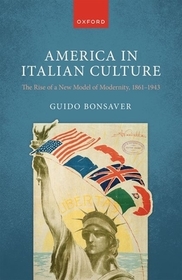
America in Italian Culture
The Rise of a New Model of Modernity, 1861-1943
- Publisher's listprice GBP 125.00
-
56 437 Ft (53 750 Ft + 5% VAT)
The price is estimated because at the time of ordering we do not know what conversion rates will apply to HUF / product currency when the book arrives. In case HUF is weaker, the price increases slightly, in case HUF is stronger, the price goes lower slightly.
- Discount 10% (cc. 5 644 Ft off)
- Discounted price 50 794 Ft (48 375 Ft + 5% VAT)
Subcribe now and take benefit of a favourable price.
Subscribe
56 437 Ft

Availability
Estimated delivery time: In stock at the publisher, but not at Prospero's office. Delivery time approx. 3-5 weeks.
Not in stock at Prospero.
Why don't you give exact delivery time?
Delivery time is estimated on our previous experiences. We give estimations only, because we order from outside Hungary, and the delivery time mainly depends on how quickly the publisher supplies the book. Faster or slower deliveries both happen, but we do our best to supply as quickly as possible.
Product details:
- Publisher OUP Oxford
- Date of Publication 10 November 2023
- ISBN 9780198849469
- Binding Hardback
- No. of pages576 pages
- Size 240x160x30 mm
- Weight 1072 g
- Language English
- Illustrations more than 100 illustrations 453
Categories
Short description:
When Italy unified in 1861, America was emerging as a world power, and advances in communication allowed Italians a view of American life to which they could aspire. America in Italian Culture traces this huge cultural shift, looking at how US fiction, comics, music, and film came to dominate Italian culture, even as the countries went to war.
MoreLong description:
When America began to emerge as a world power at the end of the nineteenth century, Italy was a young nation, recently unified. The technological advances brought about by electricity and the combustion engine were vastly speeding up the capacity of news, ideas, and artefacts to travel internationally. Furthermore, improved literacy and social reforms had produced an Italian working class with increased time, money, and education. At the turn of the century, if Italy's ruling elite continued the tradition of viewing Paris as a model of sophistication and good taste, millions of lowly-educated Italians began to dream of America, and many bought a transatlantic ticket to migrate there.
By the 1920s, Italians were encountering America through Hollywood films and, thanks to illustrated magazines, they were mesmerised by the sight of Manhattan's futuristic skyline and by news of American lifestyle. The USA offered a model of modernity which flouted national borders and spoke to all. It could be snubbed, adored, or transformed for one's personal use, but it could not be ignored.
Perversely, Italy was by then in the hands of a totalitarian dictatorship, Mussolini's Fascism. What were the effects of the nationalistic policies and campaigns aimed at protecting Italians from this supposedly pernicious foreign influence? What did Mussolini think of America? Why were jazz, American literature, and comics so popular, even as the USA became Italy's political enemy? America in Italian Culture provides a scholarly and captivating narrative of this epochal shift in Italian culture.
Bonsaver's monograph is well balanced and provides in-depth insights despite the extended timeframe considered and the vast corpus analyzed...America in Italian Culture is thus a valuable addition to the literature, offering reflections on the influence of American culture and the way that anti-Americanism developed fueled by Fascist policies and restrictions.
Table of Contents:
Preface
Introduction
Part 1: The Discovery of America: 1861-1919
Cross-national Influence in Post-Unification Italy
The Idea of America in Italy's Two Nations
American Mass Production and the Dawn of Italian Mass Culture
American Letters: Literature, Opera Librettos, and Pragmatism
The Great War and the Arrival of Jazz
Part 2: America in Fascist Italy, 1922-1943
The USA as a Mirror of Modernity
The Craze for American Literature and Comics, and the Plight of the English Language
Dancing to Jazz on Fascist Airwaves
The Lure of Hollywood
American Culture in Fascism's Final Years (1938-1943)
Conclusion

