

- Publisher's listprice GBP 300.00
-
135 450 Ft (129 000 Ft + 5% VAT)
The price is estimated because at the time of ordering we do not know what conversion rates will apply to HUF / product currency when the book arrives. In case HUF is weaker, the price increases slightly, in case HUF is stronger, the price goes lower slightly.
- Discount 10% (cc. 13 545 Ft off)
- Discounted price 121 905 Ft (116 100 Ft + 5% VAT)
Subcribe now and take benefit of a favourable price.
Subscribe
135 450 Ft

Availability
printed on demand
Why don't you give exact delivery time?
Delivery time is estimated on our previous experiences. We give estimations only, because we order from outside Hungary, and the delivery time mainly depends on how quickly the publisher supplies the book. Faster or slower deliveries both happen, but we do our best to supply as quickly as possible.
Product details:
- Publisher Clarendon Press
- Date of Publication 28 December 1995
- ISBN 9780198280125
- Binding Hardback
- No. of pages512 pages
- Size 224x145x34 mm
- Weight 769 g
- Language English 0
Categories
Short description:
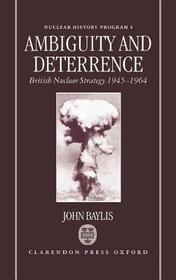
This book focuses on the disagreements which existed in British political and military circles over nuclear strategy during the period from 1945 to 1964. Based on recently released documents, the book argues that British policy in this important area was much more ambiguous and much less coherent than is usually supposed.
MoreLong description:
Ambiguity and Deterrence focuses on the role of competing strategic beliefs in the formulation of British nuclear strategy between 1945 and 1964. Based on recently released documents, it is argued that the British approach to nuclear weapons during this formative period was characterized by paradox and ambiguity. The paradox was that while there was a widespread consensus in political and military circles in favour of nuclear deterrence, there were constant disagreements over the requirements of an effective deterrent policy. These disagreements centred on six main questions: whether deterrence was best achieved through `punishment' or `denial'; whether deterrence necessitated nuclear superiority; whether preparations had to be made for a long war or a short war; what strategic implications followed from nuclear stalemate; whether limited nuclear wars could be fought without escalation to all-out nuclear war; and whether pre-emption was politically acceptable and militarily necessary. It is argued that the failure of successive governments to provide clear political direction on these issues meant that British nuclear strategy was more ambiguous and much less coherent than is usually supposed.
This study, as its extensive bibliography testifies, covers well-trodden ground, but in its shrewd use of sources, some of them newly available, it throws a thought-provoking light on the subject. Professor Baylis exposes rigorously but objectively the various contradictions and weaknesses in ministerial and Chiefs' of Staff papers of the period ... When the documents of 1965/70 are released a sequel to Professor Baylis's compelling book, assessing how these changes affected decision-making, will make fascinating reading.

