

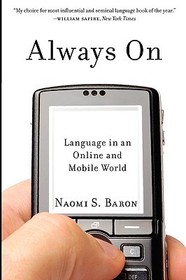
Always On
Language in an Online and Mobile World
- Publisher's listprice GBP 25.99
-
12 416 Ft (11 825 Ft + 5% VAT)
The price is estimated because at the time of ordering we do not know what conversion rates will apply to HUF / product currency when the book arrives. In case HUF is weaker, the price increases slightly, in case HUF is stronger, the price goes lower slightly.
- Discount 10% (cc. 1 242 Ft off)
- Discounted price 11 175 Ft (10 643 Ft + 5% VAT)
Subcribe now and take benefit of a favourable price.
Subscribe
12 416 Ft

Availability
printed on demand
Why don't you give exact delivery time?
Delivery time is estimated on our previous experiences. We give estimations only, because we order from outside Hungary, and the delivery time mainly depends on how quickly the publisher supplies the book. Faster or slower deliveries both happen, but we do our best to supply as quickly as possible.
Product details:
- Publisher OUP USA
- Date of Publication 18 March 2010
- ISBN 9780199735440
- Binding Paperback
- No. of pages304 pages
- Size 231x155x25 mm
- Weight 386 g
- Language English
- Illustrations 8 black and white halftones 0
Categories
Short description:
Online and mobile technologies are profoundly influencing how we read and write, speak and listen, but not in the ways you might suppose. Always On draws upon a decade of research to reveal how instant messaging, cell phones, multitasking, Facebook, blogs, and internet search functions are reshaping social interaction and written culture.
MoreLong description:
In Always On, Naomi S. Baron reveals that online and mobile technologies-including instant messaging, cell phones, multitasking, Facebooks, blogs, and wikis - are profoundly influencing how we read and write, speak and listen, but not in the ways we might suppose.
Baron draws on a decade of research to provide an eye-opening look at language in an online and mobile world. She reveals for instance that email, IM, and text messaging have had surprisingly little impact on student writing. Electronic media has magnified the laid-back ¨whatever¨ attitude toward formal writing that young people everywhere have embraced, but it is not a cause of it. A more troubling trend, according to Baron, is the myriad ways in which we block incoming IMs, camouflage ourselves on Facebook, and use ring tones or caller ID to screen incoming calls on our mobile phones. Our ability to decide who to talk to, she argues, is likely to be among the most lasting influences that information technology has upon the ways we communicate with one another. Moreover, as more and more people are älways on¨ one technology or another-whether communicating, working, or just surfing the web or playing games-we have to ask what kind of people do we become, as individuals and as family members or friends, if the relationships we form must increasingly compete for our attention with digital media?
Our 300-year-old written culture is on the verge of redefinition, Baron notes. It's up to us to determine how and when we use language technologies, and to weigh the personal and social benefits-and costs-of being älways on.¨ This engaging and lucidly-crafted book gives us the tools for taking on these challenges.
Naomi Baron artfully combines historical surveys, research summaries, and findings of her own to give us a comprehensive, insightful, and thoughtful handbook for understanding electronic communication-what it is, how it works, and how it's changing our lives and our interpersonal relationships.
Table of Contents:
Preface
Email to Your Brain: Language in an Online and Mobile World
Language Online: The Basics
Controlling the Volume: Everyone a Language Czar
Are Instant Messages Speech? The World of IM
My Best Day: Managing "Buddies" and "Friends"
Having Your Say: Blogs and Beyond
Going Mobile: Cell Phones in Context
"Whatever": Is the Internet Destroying Language?
Gresham's Ghost: Challenges to Written Culture
The People We Become: Costs of Being Always On

