

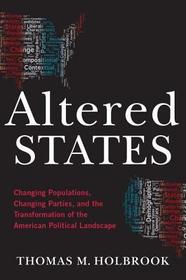
Altered States
Changing Populations, Changing Parties, and the Transformation of the American Political Landscape
- Publisher's listprice GBP 20.99
-
9 476 Ft (9 025 Ft + 5% VAT)
The price is estimated because at the time of ordering we do not know what conversion rates will apply to HUF / product currency when the book arrives. In case HUF is weaker, the price increases slightly, in case HUF is stronger, the price goes lower slightly.
- Discount 10% (cc. 947 Ft off)
- Discounted price 8 529 Ft (8 123 Ft + 5% VAT)
Subcribe now and take benefit of a favourable price.
Subscribe
9 476 Ft

Availability
printed on demand
Why don't you give exact delivery time?
Delivery time is estimated on our previous experiences. We give estimations only, because we order from outside Hungary, and the delivery time mainly depends on how quickly the publisher supplies the book. Faster or slower deliveries both happen, but we do our best to supply as quickly as possible.
Product details:
- Publisher OUP USA
- Date of Publication 4 August 2016
- ISBN 9780190269135
- Binding Paperback
- No. of pages234 pages
- Size 231x155x15 mm
- Weight 272 g
- Language English 0
Categories
Short description:
In Altered States, Thomas Holbrook looks at electoral change in presidential elections since 1972, documenting the magnitude, direction and consequences of changes in party support in the states. He finds that the Democrats do not have a "lock" on the Electoral College, but that their position has improved dramatically over the past forty years in a number of formerly competitive or Republican-leaning states in the Northeast, Southeast, and Southwest.
MoreLong description:
The 2012 presidential elections represented the second consecutive defeat for the Republican Party, and its fourth defeat out of the last six presidential elections. In recent years both Republican and Democratic strategists and pundits have spoken of an emerging Democratic Party "lock" on the Electoral College and speculated that even in the wake of Republican victories in Congress, presidential candidates are still at a major disadvantage due to the party's increasing demographic and geographic isolation.
In Altered States, Thomas Holbrook looks at change in party fortunes in presidential elections since 1972, documenting the magnitude, direction, and consequences of changes in party support in the states. He finds that the Democrats do not have a "lock" on the Electoral College, but that their position has improved dramatically over the past forty years in a number of formerly competitive or Republican-leaning states in the Northeast, Southeast, and Southwest. Republican candidates have made many fewer gains, mostly improving their position in "misplaced," formerly Democratic states, such as Kentucky and West Virginia, or in already deeply Republican states in the Plains and Mountain West. Holbrook looks at the ways that changes in the racial and ethnic composition of the state electorates, internal (state to state) and external (foreign born) migratory patterns, and changes in other key demographic and political characteristics drive these changes. Additionally, he explores the ways in which increasing partisan polarization at the national level has altered group-based party linkages and contributed to changes in party support at the state level. These factors, along with an increasingly inefficient distribution of Republican votes, have converted what was once a Republican edge in electoral votes to an advantage for Democratic presidential candidates.
Table of Contents:
Acknowledgments
List of Figures
List of Tables
Chapter 1: The Changing Political Landscape
Chapter 2: How Does Political Change Occur?
Chapter 3: Population Migration and Political Change
Chapter 4: Compositional Change and Political Change
Chapter 5: Changing Political Context and Changing State Outcomes
Chapter 6: Demographic and Political Change
Appendix
Notes
References
Index

