

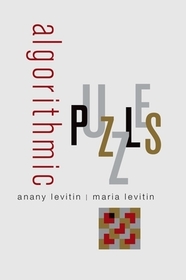
Algorithmic Puzzles
- Publisher's listprice GBP 35.99
-
16 249 Ft (15 475 Ft + 5% VAT)
The price is estimated because at the time of ordering we do not know what conversion rates will apply to HUF / product currency when the book arrives. In case HUF is weaker, the price increases slightly, in case HUF is stronger, the price goes lower slightly.
- Discount 10% (cc. 1 625 Ft off)
- Discounted price 14 624 Ft (13 928 Ft + 5% VAT)
Subcribe now and take benefit of a favourable price.
Subscribe
16 249 Ft

Availability
printed on demand
Why don't you give exact delivery time?
Delivery time is estimated on our previous experiences. We give estimations only, because we order from outside Hungary, and the delivery time mainly depends on how quickly the publisher supplies the book. Faster or slower deliveries both happen, but we do our best to supply as quickly as possible.
Product details:
- Publisher OUP USA
- Date of Publication 3 November 2011
- ISBN 9780199740444
- Binding Paperback
- No. of pages280 pages
- Size 234x155x14 mm
- Weight 399 g
- Language English
- Illustrations 249 b&w 0
Categories
Short description:
Algorithmic puzzles are puzzles involving well-defined procedures for solving problems. This book will provide an enjoyable and accessible introduction to algorithmic puzzles that will develop the reader's algorithmic thinking.
MoreLong description:
Algorithmic puzzles are puzzles involving well-defined procedures for solving problems. This book will provide an enjoyable and accessible introduction to algorithmic puzzles that will develop the reader's algorithmic thinking.
The first part of this book is a tutorial on algorithm design strategies and analysis techniques. Algorithm design strategies -- exhaustive search, backtracking, divide-and-conquer and a few others -- are general approaches to designing step-by-step instructions for solving problems. Analysis techniques are methods for investigating such procedures to answer questions about the ultimate result of the procedure or how many steps are executed before the procedure stops. The discussion is an elementary level, with puzzle examples, and requires neither programming nor mathematics beyond a secondary school level. Thus, the tutorial provides a gentle and entertaining introduction to main ideas in high-level algorithmic problem solving.
The second and main part of the book contains 150 puzzles, from centuries-old classics to newcomers often asked during job interviews at computing, engineering, and financial companies. The puzzles are divided into three groups by their difficulty levels. The first fifty puzzles in the Easier Puzzles section require only middle school mathematics. The sixty puzzle of average difficulty and forty harder puzzles require just high school mathematics plus a few topics such as binary numbers and simple recurrences, which are reviewed in the tutorial.
All the puzzles are provided with hints, detailed solutions, and brief comments. The comments deal with the puzzle origins and design or analysis techniques used in the solution. The book should be of interest to puzzle lovers, students and teachers of algorithm courses, and persons expecting to be given puzzles during job interviews.
Indeed, I would say that this is a book that any mathematical puzzle enthusiast ought to consider buying.
Table of Contents:
Preface
List of Puzzles
Tutorial Puzzles
Main Section Puzzles
1. Tutorials
General Strategies for Algorithm Design
Analysis Techniques
2. Puzzles
Easier Puzzles (
1 -
50)
Medium Dic culty Puzzles (51 - 110)
Harder Puzzles (
111 - 150)
3. Hints
4. Solutions
References
Design Strategy and Analysis Index
Index of Terms and Names

