

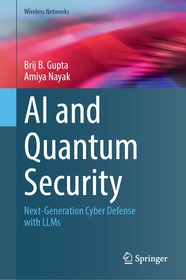
- Publisher's listprice EUR 69.54
-
27 162 Ft (25 868 Ft + 5% VAT)
The price is estimated because at the time of ordering we do not know what conversion rates will apply to HUF / product currency when the book arrives. In case HUF is weaker, the price increases slightly, in case HUF is stronger, the price goes lower slightly.
- Discount 12% (cc. 3 260 Ft off)
- Discounted price 23 902 Ft (22 764 Ft + 5% VAT)
- Discount is valid until: 16 September 2026
Subcribe now and take benefit of a favourable price.
Subscribe
23 902 Ft

Availability
Not yet published.
Why don't you give exact delivery time?
Delivery time is estimated on our previous experiences. We give estimations only, because we order from outside Hungary, and the delivery time mainly depends on how quickly the publisher supplies the book. Faster or slower deliveries both happen, but we do our best to supply as quickly as possible.
Product details:
- Publisher Springer Nature Switzerland
- Date of Publication 17 September 2026
- ISBN 9783032230959
- Binding Hardback
- No. of pages195 pages
- Size 235x155 mm
- Language English
- Illustrations XVI, 195 p. 47 illus., 21 illus. in color. 700
Categories
Long description:
"
This book provides a comprehensive guide to integrating Artificial Intelligence (AI), Large Language Models (LLMs), and quantum-safe security mechanisms into modern cybersecurity practices. It begins by examining the evolving cyber threat landscape and the growing need for intelligent, adaptive defense mechanisms. Also, the role of AI, LLMs, and quantum computing in cybersecurity, outlining the book’s objectives and structure are introduced. The fundamentals of LLM architectures and training methodologies are explored, followed by their practical applications in threat detection, malware analysis, phishing prevention, and automated incident response.
Practical integration of LLMs into cybersecurity frameworks is discussed, including enhancements to intrusion detection systems, security information, Event Management (SIEM) platforms, and real-time threat intelligence. Real-world case studies highlight successful deployments. This book also addresses key challenges such as interpretability, scalability, ethical concerns, bias, and adversarial vulnerabilities, offering mitigation strategies and best practices. The quantum computing section examines threats to classical cryptography and presents quantum-safe solutions, including post-quantum cryptography and Quantum Key Distribution (QKD). The convergence of AI and quantum-safe security is explored, showing how LLMs can support quantum-resilient defenses.
This book is designed for cybersecurity professionals, researchers, and policymakers seeking effective strategies to secure increasingly complex digital environments. Advanced-level students majoring in computer science and/or ML/DL engineering will also find this book useful as a reference.
" MoreTable of Contents:
"
Chapter 1. Introduction.- Chapter 2. Foundations of Large Language Models in Cybersecurity.- Chapter 3. Integrating LLMs into Cyber Defense Strategies.- Chapter 4. Challenges and Limitations of LLMs in Cybersecurity.- Chapter 5. Quantum Computing: A New Paradigm in Cybersecurity.- Chapter 6. Quantum-Safe Security Measures.- Chapter 7. Synergizing LLMs and Quantum-Safe Security.- Chapter 8. Future Trends and Research Directions.
" More
