

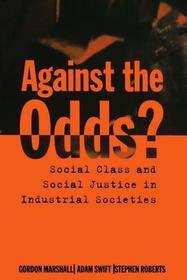
Against the Odds?
Social Class and Social Justice in Industrial Societies
- Publisher's listprice GBP 45.99
-
20 764 Ft (19 775 Ft + 5% VAT)
The price is estimated because at the time of ordering we do not know what conversion rates will apply to HUF / product currency when the book arrives. In case HUF is weaker, the price increases slightly, in case HUF is stronger, the price goes lower slightly.
- Discount 10% (cc. 2 076 Ft off)
- Discounted price 18 687 Ft (17 798 Ft + 5% VAT)
Subcribe now and take benefit of a favourable price.
Subscribe
20 764 Ft

Availability
printed on demand
Why don't you give exact delivery time?
Delivery time is estimated on our previous experiences. We give estimations only, because we order from outside Hungary, and the delivery time mainly depends on how quickly the publisher supplies the book. Faster or slower deliveries both happen, but we do our best to supply as quickly as possible.
Product details:
- Publisher Clarendon Press
- Date of Publication 8 May 1997
- ISBN 9780198292395
- Binding Paperback
- No. of pages278 pages
- Size 234x156x16 mm
- Weight 423 g
- Language English
- Illustrations line figures, tables 0
Categories
Short description:
What is the relation between social class and social justice? This is currently a matter of public as well as academic interest. In this compelling new study the authors bring together recent developments in normative thinking about social justice with new empirical findings about educational attainment and social mobility. The result is a path-breaking contribution to the study of class and justice, one which will be of interest to sociologists and political theorists for years to come.
MoreLong description:
What is the relation between social class and social justice? This is currently a matter of public as well as academic controversy. While nobody would deny that the distribution of rewards in industrial societies is unequal, there is sharp disagreement about whether this inequality can be justified. Some see existing patterns of social mobility as evidence of inequality of opportunity. Others regard them as meritocratic, simply reflecting the distribution of abilities among the population. This fascinating, interdisciplinary study brings together recent developments in normative thinking about social justice with new empirical findings about educational attainment and social mobility. The result is a path-breaking contribution to our thinking about issues of class and justice, one that will be of interest to both sociologists and political theorists for many years to come.
This is exactly what is needed to bring moral relevance to the calculus of class ... Anyone who has experience of this kind of comparative research can only admire the achievements here. The theoretical part is equally impressive and gives original insights into such difficult and intricate problems as fairness, social justice and meritocracy.

