

- Publisher's listprice GBP 39.99
-
18 055 Ft (17 195 Ft + 5% VAT)
The price is estimated because at the time of ordering we do not know what conversion rates will apply to HUF / product currency when the book arrives. In case HUF is weaker, the price increases slightly, in case HUF is stronger, the price goes lower slightly.
- Discount 10% (cc. 1 806 Ft off)
- Discounted price 16 249 Ft (15 476 Ft + 5% VAT)
Subcribe now and take benefit of a favourable price.
Subscribe
18 055 Ft

Availability
printed on demand
Why don't you give exact delivery time?
Delivery time is estimated on our previous experiences. We give estimations only, because we order from outside Hungary, and the delivery time mainly depends on how quickly the publisher supplies the book. Faster or slower deliveries both happen, but we do our best to supply as quickly as possible.
Product details:
- Publisher OUP Oxford
- Date of Publication 27 July 2017
- ISBN 9780198744009
- Binding Hardback
- No. of pages240 pages
- Size 242x173x19 mm
- Weight 486 g
- Language English 0
Categories
Short description:
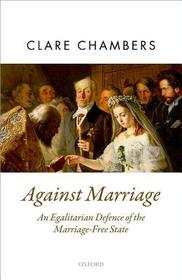
Clare Chambers argues that marriage violates both equality and liberty and should not be trecognized by the state. She shows how feminist and liberal principles require creation of a marriage-free state: one in which private marriages, whether religious or secular, would have no legal status.
MoreLong description:
Against Marriage is a radical argument for the abolition of state-recognised marriage. Clare Chambers argues that state-recognised marriage violates both equality and liberty, even when expanded to include same-sex couples. Instead Chambers proposes the marriage-free state: an egalitarian state in which religious or secular marriages are permitted but have no legal status.
Part I makes the case against marriage. Chambers investigates the critique of marriage that has developed within feminist and liberal theory. Feminists have long argued that marriage is a violation of equality since it is both sexist and heterosexist. Chambers endorses the feminist view and argues, in contrast to recent egalitarian pro-marriage movements, that same-sex marriage is not enough to make marriage equal. Chambers argues that state-recognised marriage is also problematic for liberalism, particularly political liberalism, since it imposes a controversial, hierarchical conception of the family that excludes many adults and children.
Part II sets out the case for the marriage-free state. Chambers critically assesses recent theories that attempt to make marriage egalitarian, either by replacing it with relationship contracts or by replacing it with alternative statuses such as civil union. She then sets out a new model for the legal regulation of personal relationships. In the marriage-free state regulation is based on relationship practices not relationship status, and these practices are regulated separately rather than as a bundle. The marriage-free state thus employs piecemeal, practice-based regulation. Finally, Chambers considers how the marriage-free state should respond to unequal religious marriage. The result is an inspiring egalitarian approach that fits the diversity of real relationships.
The book is interesting and accessible, and at the cutting edge of scholarly work about alternatives to marriage.
Table of Contents:
Introduction
Part One: Against Marriage
Marriage as a Violation of Equality
Marriage as a Violation of Liberty
A Liberal Defence of Marriage?
Part Two: The Marriage-Free State
The Limitations of Contract
Regulating Relationships in the Marriage-Free State
Marriage in the Marriage-Free State
Conclusion

