

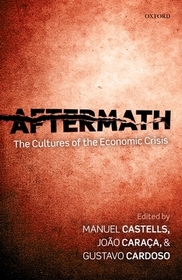
Aftermath
The Cultures of the Economic Crisis
- Publisher's listprice GBP 31.99
-
15 283 Ft (14 555 Ft + 5% VAT)
The price is estimated because at the time of ordering we do not know what conversion rates will apply to HUF / product currency when the book arrives. In case HUF is weaker, the price increases slightly, in case HUF is stronger, the price goes lower slightly.
- Discount 10% (cc. 1 528 Ft off)
- Discounted price 13 754 Ft (13 100 Ft + 5% VAT)
Subcribe now and take benefit of a favourable price.
Subscribe
15 283 Ft

Availability
Estimated delivery time: In stock at the publisher, but not at Prospero's office. Delivery time approx. 3-5 weeks.
Not in stock at Prospero.
Why don't you give exact delivery time?
Delivery time is estimated on our previous experiences. We give estimations only, because we order from outside Hungary, and the delivery time mainly depends on how quickly the publisher supplies the book. Faster or slower deliveries both happen, but we do our best to supply as quickly as possible.
Product details:
- Publisher OUP Oxford
- Date of Publication 27 March 2014
- ISBN 9780199677382
- Binding Paperback
- No. of pages330 pages
- Size 234x156x19 mm
- Weight 494 g
- Language English 0
Categories
Short description:
The consequences of the financial crisis may be uncertain, but are sure to reach deep into the body politic, civil society, welfare systems, and reform. This collection of essays by leading international sociologists and social scientists explores the likely outcomes and consequences
MoreLong description:
The crisis of global capitalism that has unfolded since 2008 is more than an economic crisis. It is structural and multidimensional. The sequence of events that have taken place in its aftermath show that we are entering a world that is very different from the social and economic conditions that characterized the rise of global, informational capitalism in the preceding three decades. The policies and strategies that were intended to manage the crisis--with mixed results depending on the country--may usher in a distinctly different economic and institutional system, as the New Deal, the construction of the European Welfare State, and the Bretton Woods global financial architecture all gave rise to a new form of capitalism in the aftermath of the 1930s Depression, and World War II.
This volume examines the cultures and institutions at the root of the crisis, as well as the conflicts and debates that may lead to a new social landscape, including the rise of alternative economic cultures in the social movements that have sprung up around the world. This collection of essays presents the results of a shared project of reflection by a group of international sociologists and social scientists, led by Manuel Castells. They conclude that to address life beyond the crisis, we need nothing less than a complete transformation of the mind-set that led to bankruptcy and despair, and to economies and societies based on an unsustainable model of speculative finance and political irresponsibility.
The discussion of the crisis of global capitalism offered in this book marks a breakthrough. The work ranges far more widely than the usual crop of purely economic analyses and rightly so.
Table of Contents:
The Cultures of the Economic Crisis: An Introduction
PRELUDE
The Rolling Apocalypse of Contemporary History
The Separation of Cultures and the Decline of Modernity
WHICH CRISIS? WHOSE CRISIS?
The Metamorphosis of a Crisis
Financial Crisis or Societal Mutation?
DEALING WITH THE CRISIS
Branding the Crisis
In Nationalism We Trust?
Crisis, Identity and the Welfare State
BEYOND THE CRISIS
Surfing the Crisis: Cultures of Belonging and Networked Social Change
Beyond the Crisis: The Emergence of Alternative Economic Practises
THE NON-GLOBAL GLOBAL CRISIS
No Crisis in China? The Rise of China's Social Crisis
A Non-Global Crisis? Challenging the Crisis in Latin America
AFTERMATH?

