

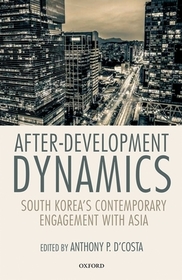
After-Development Dynamics
South Korea's Contemporary Engagement with Asia
- Publisher's listprice GBP 122.50
-
55 308 Ft (52 675 Ft + 5% VAT)
The price is estimated because at the time of ordering we do not know what conversion rates will apply to HUF / product currency when the book arrives. In case HUF is weaker, the price increases slightly, in case HUF is stronger, the price goes lower slightly.
- Discount 10% (cc. 5 531 Ft off)
- Discounted price 49 778 Ft (47 408 Ft + 5% VAT)
Subcribe now and take benefit of a favourable price.
Subscribe
55 308 Ft

Availability
printed on demand
Why don't you give exact delivery time?
Delivery time is estimated on our previous experiences. We give estimations only, because we order from outside Hungary, and the delivery time mainly depends on how quickly the publisher supplies the book. Faster or slower deliveries both happen, but we do our best to supply as quickly as possible.
Product details:
- Publisher OUP Oxford
- Date of Publication 30 July 2015
- ISBN 9780198729433
- Binding Hardback
- No. of pages308 pages
- Size 240x172x25 mm
- Weight 626 g
- Language English
- Illustrations 8 Figures and 32 Tables 0
Categories
Short description:
This book seeks to understand what a successful country like South Korea does after it has attained 'development' and economic maturity. It looks at Korea and Asian regionalism; Korean business and innovation strategies in Asia; and Asian migration and immigrants in Korea.
MoreLong description:
The South Korean economic development trajectory has been widely studied and is well understood. From an impoverished war-torn nation, the country has progressed on all fronts, including a ten-fold increase in per capita income over a 40 year period. It stands out internationally when it comes to education and politically it has moved away from authoritarianism to a more spirited democratic system. In short, it seems to have achieved it all. The question then is, what does a country do after it has attained development?
This volume examines Korea's strategic engagement with Asia as a response to the limits of the home market. Access to new markets and resources in Asia through exports and foreign investment are critical. Additionally, with Korea's ongoing demographic crisis, its engagement with foreign workers is also inevitable. After-Development Dynamics explores how Korea is responding through regional integration, strategic industrial upgrading of exports, foreign markets and resources, and coping with migrants, including unskilled workers, students, and professionals. The transfer of Korean business and employment practices through investment to other countries and accommodating foreigners is not trouble-free. Further, prosperity imposes demands for increased social welfare, while the workings of contemporary global capitalism introduce new sources of inequality. Sharing that prosperity with small firms, irregular workers, and women becomes critical. This volume presents the key internal challenges facing Korean society and suggests multiple ways to address them as a related response to Korea's after-development prosperity.
The South Korean economy has long since moved beyond the stage of catch-up growth where development strategy mostly follows paths pioneered by others. Today South Korea is facing a variety of new challenges that call for unique solutions particularly in the international sphere. This volume edited by Anthony D'Costa includes a collection of stimulating essays on how Korean businesses, the government, and the population are responding to these challenges. The emphasis is particularly strong on how government and businesses are responding to efforts to expand economic relations abroad and with the increasing numbers of foreign professionals, students, and migrants in Korea. Anyone interested in understanding the international challenges Korea is facing today, and in the near future, will benefit from these studies.
Table of Contents:
After-Development Dynamics: South Korea's Contemporary Engagements with Asia
PART I: Korea and Regional Integration
Economic Clustering in Northeast Asia: China, Japan, and Korean Integration
South Korea's Green Growth Strategy and East Asia's New Developmentalism
Globalization, Upgrading, and Regional Engagement: International Coproduction and the Korean Animation Industry in Asia
PART II: Korean Business Practices and Innovation Strategies in Asia
Development and Strategy of Korean Patent Filings in China
Cross-Border Hybridization: The Internationalization of a Korea-based Manufacturer in China
The Transfer of HRM Practices to Indian Subsidiaries in a South Korean MNC in the Auto Industry
Diffusion of a Korean Labour-Management Partnership Model across Asia: The Case of LG Electronics
Limits to Korean Business Expansion: The Case of POSCO in India
PART III: Migration, Adjustments, and Korea's Imperatives
Foreign Professionals in South Korea: Integration or Alienation?
A Pathway of Knowledge Transfer from Korea to Asian Countries: Korea's Policies on Foreign-Born Students in Science and Engineering
Assimilation and Socio-Economic Hardship of Asian Migrants in South Korea
Reconstructing and Negotiating Gendered Identities: Marriage Migration of Asian Women to South Korea
What's Next After Development? Some Policy Directions for Korea

