

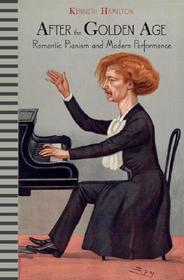
After the Golden Age
Romantic Pianism and Modern Performance
- Publisher's listprice GBP 48.49
-
21 893 Ft (20 850 Ft + 5% VAT)
The price is estimated because at the time of ordering we do not know what conversion rates will apply to HUF / product currency when the book arrives. In case HUF is weaker, the price increases slightly, in case HUF is stronger, the price goes lower slightly.
- Discount 10% (cc. 2 189 Ft off)
- Discounted price 19 703 Ft (18 765 Ft + 5% VAT)
Subcribe now and take benefit of a favourable price.
Subscribe
21 893 Ft

Availability
printed on demand
Why don't you give exact delivery time?
Delivery time is estimated on our previous experiences. We give estimations only, because we order from outside Hungary, and the delivery time mainly depends on how quickly the publisher supplies the book. Faster or slower deliveries both happen, but we do our best to supply as quickly as possible.
Product details:
- Publisher OUP USA
- Date of Publication 6 December 2007
- ISBN 9780195178265
- Binding Hardback
- No. of pages320 pages
- Size 165x236x25 mm
- Weight 590 g
- Language English
- Illustrations 2 halftones, 44 line illus. 0
Categories
Long description:
Kenneth Hamilton's book engagingly and lucidly dissects the oft-invoked myth of a Great Tradition, or Golden Age of Pianism. It is written both for players and for members of their audiences by a pianist who believes that scholarship and readability can go hand-in-hand. Hamilton discusses in meticulous yet lively detail the performance-style of great pianists from Liszt to Paderewski, and delves into the far-from-inevitable development of the piano recital. He entertainingly recounts how classical concerts evolved from exuberant, sometimes riotous events into the formal, funereal trotting out of predictable pieces they can be today, how an often unhistorical "respect for the score" began to replace pianists' improvisations and adaptations, and how the clinical custom arose that an audience should be seen and not heard. Pianists will find food for thought here on their repertoire and the traditions of its performance. Hamilton chronicles why pianists of the past did not always begin a piece with the first note of the score, nor end with the last. He emphasizes that anxiety over wrong notes is a relatively recent psychosis, and playing entirely from memory a relatively recent requirement. Audiences will encounter a vivid account of how drastically different are the recitals they attend compared to concerts of the past, and how their own role has diminished from noisily active participants in the concert experience to passive recipients of artistic benediction from the stage. They will discover when cowed listeners eventually stopped applauding between movements, and why they stopped talking loudly during them. The book's broad message proclaims that there is nothing divinely ordained about our own concert-practices, programming and piano-performance styles. Many aspects of the modern approach are unhistorical-some laudable, some merely ludicrous. They are also far removed from those fondly, if deceptively, remembered as constituting a Golden Age.
One can make too much of the handing down of great traditions of piano playing, as Kenneth Hamilton demonstrates in one of the best music books to be published in the last twelve months: his erudite, revealing and wittily subversive study of the Liszt-Paderewski years and the rather primmer world we inhabit today.

