
• Contact

  • Newsletter

  • About us

  • Delivery options

  • Prospero Book Market Podcast

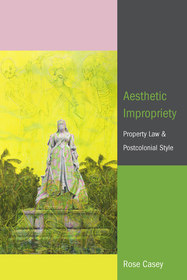
  • Aesthetic Impropriety: Property Law and Postcolonial Style

    Aesthetic Impropriety by Casey, Rose;

    Property Law and Postcolonial Style

      • GET 10% OFF

      • The discount is only available for 'Alert of Favourite Topics' newsletter recipients.
      • Publisher's listprice GBP 24.99
      • The price is estimated because at the time of ordering we do not know what conversion rates will apply to HUF / product currency when the book arrives. In case HUF is weaker, the price increases slightly, in case HUF is stronger, the price goes lower slightly.

        11 938 Ft (11 370 Ft + 5% VAT)
      • Discount 10% (cc. 1 194 Ft off)
      • Discounted price 10 745 Ft (10 233 Ft + 5% VAT)

    11 938 Ft

    db

    Availability

    Estimated delivery time: In stock at the publisher, but not at Prospero's office. Delivery time approx. 3-5 weeks.
    Not in stock at Prospero.

    Why don't you give exact delivery time?

    Delivery time is estimated on our previous experiences. We give estimations only, because we order from outside Hungary, and the delivery time mainly depends on how quickly the publisher supplies the book. Faster or slower deliveries both happen, but we do our best to supply as quickly as possible.

    Product details:

    • Edition number 1
    • Publisher Fordham University Press
    • Date of Publication 1 July 2025
    • Number of Volumes Print PDF

    • ISBN 9781531510633
    • Binding Paperback
    • No. of pages208 pages
    • Size 229x152 mm
    • Weight 322 g
    • Language English
    • 760

    Categories

    Short description:

    Aesthetic Impropriety analyzes vanguard legal actions and literary innovations to reveal contemporary reforms to property law that are undoing law’s colonial legacies. By analyzing shared legal and aesthetic transformations, Aesthetic Impropriety argues that law and literature play vital roles in creating anticolonial world orders.

    More

    Long description:

    Across Africa, Asia, and the Americas, colonial Britain's property laws are in the process of being transformed. Aesthetic Impropriety analyzes vanguard legal actions and literary innovations to reveal contemporary reforms to property law that are undoing law's colonial legacies. Casey traces precise legal histories across distinct jurisdictions throughout the anglophone world, revealing the connection between land law and petroleum extraction in the Niger Delta, inheritance and divorce laws and gender inequality in India, intellectual property law and Indigenous dispossession in South Africa, and admiralty law and racialized non-personhood in the English Atlantic. In response to these manifold forms of dispossession, significant reforms are underway, including through common law suits, statutory reform, and proposed changes to legal doctrine.
    Casey develops the concept of aesthetic impropriety to identify shared structures of thought across legal and literary venues. She shows that writers of poetry and prose are also transforming harmful property laws: in Nigeria, Ben Okri and Chigozie Obioma have articulated symbiotic ecological relationships that are also evidenced in recent actions against petroleum companies; in India, Arundhati Roy's challenge to divorce laws has preempted similar attempts at reform in Parliament; in South Africa, Zoë Wicomb theorized protections for Indigenous modes of creative production nineteen years before they were signed into law; and in the Americas, M. NourbeSe Philip has proposed a novel method of achieving justice for the one hundred fifty enslaved people who were killed in the 1781 Zong massacre.
    Aesthetic Impropriety makes a convincing case for literature's generative capacities and registers the enduring significance of the postcolonial as a necessary framework for understanding globalized inequality in the twenty-first century. By analyzing shared legal and aesthetic transformations, Aesthetic Impropriety argues that law and literature play vital roles in creating anticolonial world orders.

    More

    Table of Contents:

    Introduction: An Aesthetic Theory of Law and Literature 1
    1. Symbiosis: Oil Extraction in the Racial Capitalocene 29
    2. Reciprocity: Female Dispossession in Inheritance and Divorce 62
    3. Accretion: Decolonizing Intellectual Property Law 90
    4. Dispersal: Admiralty Law and Raising the Dead 120
    Conclusion: Hope's Impropriety 154
    Acknowledgments 161
    Notes 165
    Works Cited 201
    Index 219

    More
    0