

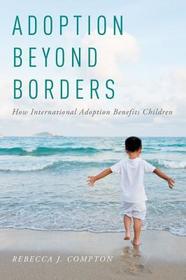
Adoption Beyond Borders
How International Adoption Benefits Children
- Publisher's listprice GBP 32.49
-
14 669 Ft (13 970 Ft + 5% VAT)
The price is estimated because at the time of ordering we do not know what conversion rates will apply to HUF / product currency when the book arrives. In case HUF is weaker, the price increases slightly, in case HUF is stronger, the price goes lower slightly.
- Discount 20% (cc. 2 934 Ft off)
- Discounted price 11 735 Ft (11 176 Ft + 5% VAT)
- Discount is valid until: 30 June 2026
Subcribe now and take benefit of a favourable price.
Subscribe
14 669 Ft

Availability
Estimated delivery time: In stock at the publisher, but not at Prospero's office. Delivery time approx. 3-5 weeks.
Not in stock at Prospero.
Why don't you give exact delivery time?
Delivery time is estimated on our previous experiences. We give estimations only, because we order from outside Hungary, and the delivery time mainly depends on how quickly the publisher supplies the book. Faster or slower deliveries both happen, but we do our best to supply as quickly as possible.
Product details:
- Publisher OUP USA
- Date of Publication 17 March 2016
- ISBN 9780190247799
- Binding Hardback
- No. of pages250 pages
- Size 236x155x27 mm
- Weight 476 g
- Language English 0
Categories
Short description:
This book provides a ringing endorsement of international adoption based on comprehensive evidence from social and biological sciences paired with the author's first-hand experience visiting a Kazakhstani orphanage for nearly a year. A balanced account of the evidence supports international adoption as a viable means of promoting child welfare.
MoreLong description:
International adoptions have decreased dramatically in the last decade, despite robust evidence of the tremendous benefits that early placement in adoptive families can confer upon children who are not able to remain with birth families. This book integrates evidence from a range of disciplines in the social and biological sciences-- including psychology, neuroscience, evolutionary biology, sociology, anthropology, and social work -- to provide a ringing endorsement of international adoption as a viable child welfare option. The author interweaves narrative accounts of her own adoption journey, which involved visiting a Kazakhstani orphanage daily for nearly a year, to illustrate the complexities and implications of the research evidence. Topics include the effects of institutionalization on children's developing brains, cognitive abilities, and socio-emotional functioning; the challenges of navigating issues of identity when adopting across national, cultural, and racial lines; how strong emotional bonds form even without genetic relatedness; and how adoptive families can address the special needs of children who experienced early neglect and deprivation, providing a supportive environment in which those children can flourish. Striving to attain a balanced, evidence-based perspective on controversial issues, the book argues that international adoption must be maintained and supported as a vital means of promoting international child welfare.
MoreTable of Contents:
PART 1: The Adopted Child: Patterns of Loss and Gain
Ch. 1: Introduction
Ch. 2: Physical and Cognitive Development
Ch. 3: Social and Emotional Development
Ch. 4: Culture, Race, and Identity
PART 2: Adoptive Families: Biological, Social, and Clinical Approaches
Ch. 5: Adoption and the Biology of Parenting
Ch. 6: Adoptive Families in Society
Ch. 7: Special Needs and Interventions
Ch. 8: Conclusions and Policy Considerations

