

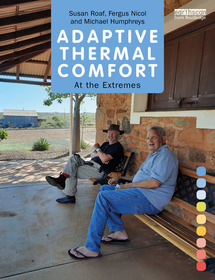
Adaptive Thermal Comfort
At the Extremes
-
GET 10% OFF
- Publisher's listprice GBP 52.99
-
25 315 Ft (24 110 Ft + 5% VAT)
The price is estimated because at the time of ordering we do not know what conversion rates will apply to HUF / product currency when the book arrives. In case HUF is weaker, the price increases slightly, in case HUF is stronger, the price goes lower slightly.
- Discount 10% (cc. 2 532 Ft off)
- Discounted price 22 784 Ft (21 699 Ft + 5% VAT)
22 784 Ft

Availability
Estimated delivery time: In stock at the publisher, but not at Prospero's office. Delivery time approx. 3-5 weeks.
Not in stock at Prospero.
Why don't you give exact delivery time?
Delivery time is estimated on our previous experiences. We give estimations only, because we order from outside Hungary, and the delivery time mainly depends on how quickly the publisher supplies the book. Faster or slower deliveries both happen, but we do our best to supply as quickly as possible.
Product details:
- Edition number 1
- Publisher Routledge
- Date of Publication 19 March 2026
- ISBN 9780415691635
- Binding Paperback
- No. of pages476 pages
- Size 246x174 mm
- Weight 940 g
- Language English
- Illustrations 233 Illustrations, color; 86 Halftones, color; 147 Line drawings, color; 21 Tables, color 696
Categories
Short description:
The book explains how comfort is ultimately the result of a conversation between people and their environments. This is the third of three volumes that builds on the practical and theoretical foundations of the subject laid out in the first two volumes.
MoreLong description:
To remain comfortable in a world of ever more extreme weather events and climate trends, we need a building revolution. Building designers, owners, managers, and occupants must prepare now for future climates with new ways to stay comfortable indoors. This book is a compendium of information on comfort that provides an overview of the complexity of the many ways that comfort is achieved in buildings. It outlines the impacts and implications of current design practices on greenhouse gas emissions from buildings and the health and well-being of people in them. In reality, many modern buildings, and particularly homes, are already failing in various ways. During extreme weather events, they overheat. During power outages, many buildings do not even remain habitable. During the COVID pandemic, cross-infections between occupants were rife in buildings like hospitals and hotels without opening windows. As energy prices soared and globally economies flatlined, many found themselves unable to pay for high-cost comfort solutions and so either had to change their lifestyles and expectations or learn to live with discomfort. Underlying many of the growing global problems is the trend towards an overdependence on mechanical systems to produce comfort, coupled with a decrease in the passive climatic performance of the buildings themselves. Both factors are resulting in a generation of increasingly un-resilient buildings.
The theory of adaptive thermal comfort states that people adapt to those temperatures they normally occupy, and if they become uncomfortable, they tend to change themselves or their surroundings to return to comfort, if they are able or can afford to. This is the third of three volumes, which builds on the practical and theoretical foundations of the subject laid out in the first two volumes. It builds on their premises to shape a new and better roadmap going forward for imagining, designing, and constructing adaptable buildings, and for the behavioural lifestyle changes needed to prepare humanity to survive and thrive comfortably in the very different weather and climates ahead.
'Even as the climate warms, so too does the debate about thermal comfort in buildings. Adaptive Thermal Comfort: At the Extremes is appropriately hard-hitting and insightful – a true guide for hotter times ahead.'
Jonathon Porritt, writer and campaigner, president of The Conservation Volunteers and Population Matters
'We can’t air-condition our way out of the climate crisis – this book is an essential manifesto for designing a resilient future, showing how our bodies, buildings, and cultures must adapt to a heating world.'
Prashant Kapoor, chief industry specialist, Green Buildings and Cities, Climate Business Department, IFC
'This is a truly stupendous piece of work covering all dimensions of the question of thermal comfort in buildings –historical time, location, built space and the challenge of Climate Change. A must read for designers and researchers for an urgently needed "reset" for theory and practice.'
Ashok Lall, principal of Ashok B Lall Architects, Delhi, India
'How wonderful to read a book on science that is written so clearly: for in a time of adjustment we need plain speaking… As Sue Roaf says: "the first step to escaping from an echo chamber is to realise that you are in one." May this book assist you to thrust the window of your enclosed space wide open and brave this world which created you – if you can find one that opens!'
Phil Harris, Troppo Architects
'Many congratulations on this new book. It's brimming with ideas related to radically cutting carbon in the face of the drastic rates of climate change we are now caught in.'
Aubrey Meyer, The Global Commons Institute, UK
'Adaptive Thermal Comfort: At the Extremes is a provocative reading of how comfort has been defined, captured, codified, exported and enforced in our built environment – with highly uncomfortable results for our heating world. We are honored that our projects have been identified as exemplars for localized, adaptable and culturally attuned comfort. This book is a necessary critique of how we got here and offers actionable suggestions for designers, professionals and policy-makers moving forward.'
Richard Hassell, WOHA, Singapore
More
Table of Contents:
DEDICATION
PREFACE
ACKNOWLEDGEMENTS
COMFORT IN BUILDINGS
Chapter 1. Designing for Comfort at the Extremes
Chapter 2. Dangerous Curves: The Overheating Buildings Problem
PEOPLE AND COMFORT
Chapter 3. How Bodies Adapt
Chapter 4. How People Adapt
BUILDINGS AND COMFORT
Chapter 5. How People Adapt in Buildings
Chapter 6. Comfort Clouds
COMFORT AND CULTURES
Chapter 7. Comfort, Cultures, and Customs
Chapter 8. Comfort Colonialism
THERMAL HEARTBEATS OF BUILDINGS
Chapter 9. The Thermal Heartbeats of Buildings
Chapter 10. Killer Buildings: Heatwaves
Chapter 11. Killer Buildings: Cold
ECOLOGY AND COMFORT
Chapter 12. Ecology of Comfort
Chapter 13. Heat Flows and Ecological Engineering
Chapter 14. Harvesting Comfort From Landscapes
Chapter 15. Mining Comfort From the Earth
Chapter 16. Thermal Mass and Comfort
Chapter 17. Harvesting Comfort From Sky Cycles
Chapter 18. Air, Radiation, and Comfort
Chapter 19. Thermal Landscaping of Buildings
DESIGNING FOR A HOTTER CLIMATE
Chapter 20. Reconnecting Designers to Climates
Chapter 21. Firmness, Commodity, and Delight
Chapter 22. Designing Thermally Well-Behaved Buildings
Chapter 23. Thermal Delight in Design
COMFORT AND WELLBEING
Chapter 24. Comfort and Well-Being: Physical Health
Chapter 25. Well-Being: All About the Mind
Chapter 26. Emotional Comfort and Social Well-Being
Chapter 27. Spiritual Comfort and Beliefs
Chapter 28. Adaptable Buildings = Adaptive Comfort
APPENDICES
More

