

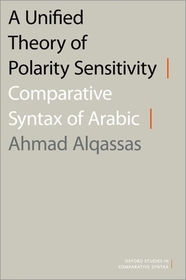
A Unified Theory of Polarity Sensitivity
Comparative Syntax of Arabic
Series: Oxford Studies in Comparative Syntax;
- Publisher's listprice GBP 105.00
-
47 407 Ft (45 150 Ft + 5% VAT)
The price is estimated because at the time of ordering we do not know what conversion rates will apply to HUF / product currency when the book arrives. In case HUF is weaker, the price increases slightly, in case HUF is stronger, the price goes lower slightly.
- Discount 10% (cc. 4 741 Ft off)
- Discounted price 42 667 Ft (40 635 Ft + 5% VAT)
Subcribe now and take benefit of a favourable price.
Subscribe
47 407 Ft

Availability
printed on demand
Why don't you give exact delivery time?
Delivery time is estimated on our previous experiences. We give estimations only, because we order from outside Hungary, and the delivery time mainly depends on how quickly the publisher supplies the book. Faster or slower deliveries both happen, but we do our best to supply as quickly as possible.
Product details:
- Publisher OUP USA
- Date of Publication 30 September 2021
- ISBN 9780197554883
- Binding Hardback
- No. of pages258 pages
- Size 160x243x20 mm
- Weight 499 g
- Language English 142
Categories
Short description:
This book examines polarity sensitivity - a ubiquitous phenomenon involving expressions such as anybody, nobody, ever, never, somebody and their counterparts in other languages. In this book, Ahmad Alqassas proposes a unified approach by examining the interaction between the various types of polarity sensitivity. Drawing on data from Standard Arabic and the major regional dialects represented by Jordanian, Egyptian, Moroccan, and Qatari, the book provides a new perspective on the syntax-semantic interface and develops a unified syntactic analysis for polarity sensitivity.
MoreLong description:
Polarity sensitivity is a ubiquitous phenomenon involving expressions such as anybody, nobody, ever, never, somebody and their counterparts in other languages. These expressions belong to different classes such as negative and positive polarity, negative concord, and negative indefinites.
In this book, Ahmad Alqassas proposes a unified approach to the study of this phenomenon that relies on examining the interaction between the various types of polarity sensitivity, with a particular focus on Arabic. Alqassas shows that treating this interaction is fundamental for scrutinizing their licensing conditions. Alqassas draws on data from Standard Arabic and the major regional dialects represented by Jordanian, Egyptian, Moroccan, and Qatari. Through the (micro)comparative approach, Alqassas explains the distributional contrasts with a minimal set of universal syntactic operations such as Merge, Move, and Agree. He also considers a fine-grained inventory of negative formal features for polarity items and their licensors. These simple features paint a complex landscape of polarity and lead to important conclusions about syntactic computation.
By engaging with the rich but under-studied landscape of Arabic polarity sensitivity, this book provides a new perspective on the syntax-semantic interface and develops a unified syntactic analysis for polarity sensitivity. These contributions have important implications for the study of Arabic and for syntactic theory more generally.
Table of Contents:
Acknowledgments
List of abbreviations
Chapter 1 Issues in the Syntax of Polarity Sensitive Items
Chapter 2 Classification of PSIs and Their Lexical Categories
Chapter 3 Licensing Negative Polarity Items
Chapter 4 Licensing Negative Concord Items
Chapter 5 PSIs with Head-Like Properties
Chapter 6 Summary and Conclusions
Bibliography
Index

