

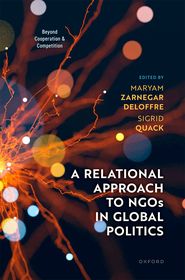
A Relational Approach to NGOs in Global Politics
Beyond Cooperation and Competition
- Publisher's listprice GBP 99.00
-
44 698 Ft (42 570 Ft + 5% VAT)
The price is estimated because at the time of ordering we do not know what conversion rates will apply to HUF / product currency when the book arrives. In case HUF is weaker, the price increases slightly, in case HUF is stronger, the price goes lower slightly.
- Discount 10% (cc. 4 470 Ft off)
- Discounted price 40 229 Ft (38 313 Ft + 5% VAT)
Subcribe now and take benefit of a favourable price.
Subscribe
44 698 Ft

Availability
Estimated delivery time: In stock at the publisher, but not at Prospero's office. Delivery time approx. 3-5 weeks.
Not in stock at Prospero.
Why don't you give exact delivery time?
Delivery time is estimated on our previous experiences. We give estimations only, because we order from outside Hungary, and the delivery time mainly depends on how quickly the publisher supplies the book. Faster or slower deliveries both happen, but we do our best to supply as quickly as possible.
Product details:
- Publisher OUP Oxford
- Date of Publication 22 May 2025
- ISBN 9780198942726
- Binding Hardback
- No. of pages288 pages
- Size 240x160x20 mm
- Weight 574 g
- Language English 606
Categories
Short description:
With a broad conceptualization of NGO-NGO relationships and in-depth analysis of the forms and processes of NGO interactions, this volume expands the understanding of NGOing, promotes synthetic knowledge about the power and effects of NGO interactions, and reveals new perspectives on processes of global governing.
MoreLong description:
This is an open access title available under the terms of a CC BY-NC-ND 4.0 International licence. It is free to read at Oxford Scholarship Online and offered as a free PDF download from OUP and selected open access locations.
How do non-governmental organizations (NGOs) create the spaces in which they act, despite all the odds that are stacked against them? How do NGOs meet the requirements of the moment, often being in the right place at the right time? Why is the sum of NGO activity frequently greater than the parts?
To answer these questions, A Relational Approach to NGOs in Global Politics analyses the ways in which NGOs relate to each other as well as with states, intergovernmental organizations, businesses, and other actors. It considers NGOs as living organizations - flexible, adaptive, creative - to examine the various NGO relationships and how they are built to surmount challenges, manage complexity, and make progress. In doing so, it sheds light on their power and agency in global politics.
Maryam Zarnegar Deloffre and Sigrid Quack develop core conceptual building blocks, such as NGOing and typologies of social interactions and relational power, which are explored in empirical studies of NGOs on a range of topics. These include legal environmental conflicts, humanitarian assistance, and counterterrorism, as well as analyses of relational forms such as super-networks, meta-associations, and mergers and acquisitions.
With a broad conceptualization of NGO-NGO relationships and in-depth analysis of the forms and processes of NGO interactions, this volume expands the understanding of NGOing, promotes synthetic knowledge about the power and effects of NGO interactions, and reveals new perspectives on processes of global governing.
Table of Contents:
Acknowledgements
List of Figures
List of Tables
Abbreviations
Notes on Contributors
A Relational Approach to NGOs in Global Politics
Part I. Social Ties
NGO–NGO Conflict: The Legal Case of Survival International v. WWF
The Power of Interpersonal Ties: INGO Relations in the Greek Refugee Crisis
NGO Mergers and Acquisitions: A Social Relational Perspective
Part II. Configurations
NGO–NGO Interactions through Individuals: Patterns and Effects for Social Rights Advocacy
Pathways to Brokerage: A Relational Approach to Understanding Global South Inter-Community NGO Networking
NGO Self-Organization and Orchestration in Ethiopia: Dynamics of Cooperation and Conflict
Part III. Sites of Interaction
Super-Networks as Sites of TAN–TAN Interaction in International Climate Politics
Coordinating Civil Society?: How NGO Associations Navigate Transnational Collaboration
NGO–NGO Interactions, Brazil’s Counterterrorism Legislation, and Beyond
Part IV. Conclusion
Conclusion: Main Findings and Future Research Directions
Index

