

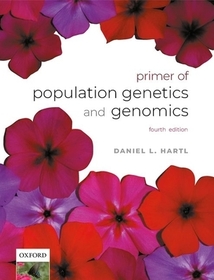
A Primer of Population Genetics and Genomics
- Publisher's listprice GBP 96.00
-
43 344 Ft (41 280 Ft + 5% VAT)
The price is estimated because at the time of ordering we do not know what conversion rates will apply to HUF / product currency when the book arrives. In case HUF is weaker, the price increases slightly, in case HUF is stronger, the price goes lower slightly.
- Discount 10% (cc. 4 334 Ft off)
- Discounted price 39 010 Ft (37 152 Ft + 5% VAT)
Subcribe now and take benefit of a favourable price.
Subscribe
43 344 Ft

Availability
printed on demand
Why don't you give exact delivery time?
Delivery time is estimated on our previous experiences. We give estimations only, because we order from outside Hungary, and the delivery time mainly depends on how quickly the publisher supplies the book. Faster or slower deliveries both happen, but we do our best to supply as quickly as possible.
Product details:
- Edition number 4
- Publisher OUP Oxford
- Date of Publication 25 June 2020
- ISBN 9780198862291
- Binding Hardback
- No. of pages320 pages
- Size 249x196x23 mm
- Weight 810 g
- Language English 7
Categories
Short description:
This accessible primer has been completely revised and updated to provide a concise but comprehensive introduction to the basic concepts of population genetics and genomics.
MoreLong description:
A Primer of Population Genetics and Genomics has been completely revised and updated to provide a concise but comprehensive introduction to the basic concepts of population genetics and genomics.
Recent textbooks have tended to focus on such specialized topics as the coalescent, molecular evolution, human population genetics, or genomics. This primer bucks that trend by encouraging a broader familiarity with, and understanding of, population genetics and genomics as a whole. The overview ranges from mating systems through the causes of evolution, molecular population genetics, and the genomics of complex traits. Interwoven are discussions of ancient DNA, gene drive, landscape genetics, identifying risk factors for complex diseases, the genomics of adaptation and speciation, and other active areas of current research. The principles are illuminated by numerous examples from a wide variety of animals, plants, microbes, and human populations. The approach also emphasizes learning by doing, which in this case means solving numerical or conceptual problems. The rationale behind this is that the use of concepts in problem-solving lead to deeper understanding and longer knowledge retention.
This accessible, introductory textbook is aimed principally at students of various levels and abilities (from senior undergraduate to postgraduate) as well as practising scientists in the fields of population genetics, ecology, evolutionary biology, computational biology, bioinformatics, biostatistics, physics, and mathematics.
Table of Contents:
Preface
Genetic Polymorphisms
Organization of Genetic Variation
Inbreeding and Population Structure
Mutation, Gene Conversion, and Migration
Natural Selection in Large Populations
Random Genetic Drift in Small Populations
Molecular Population Genetics
Population Genetics of Complex Traits
Complex Traits in Natural Populations

