

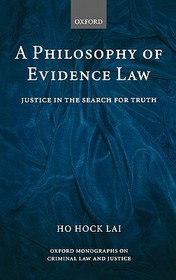
A Philosophy of Evidence Law
Justice in the Search for Truth
Series: Oxford Monographs on Criminal Law and Justice;
- Publisher's listprice GBP 125.00
-
56 437 Ft (53 750 Ft + 5% VAT)
The price is estimated because at the time of ordering we do not know what conversion rates will apply to HUF / product currency when the book arrives. In case HUF is weaker, the price increases slightly, in case HUF is stronger, the price goes lower slightly.
- Discount 10% (cc. 5 643 Ft off)
- Discounted price 50 794 Ft (48 375 Ft + 5% VAT)
Subcribe now and take benefit of a favourable price.
Subscribe
56 437 Ft

Availability
printed on demand
Why don't you give exact delivery time?
Delivery time is estimated on our previous experiences. We give estimations only, because we order from outside Hungary, and the delivery time mainly depends on how quickly the publisher supplies the book. Faster or slower deliveries both happen, but we do our best to supply as quickly as possible.
Product details:
- Publisher OUP Oxford
- Date of Publication 6 March 2008
- ISBN 9780199228300
- Binding Hardback
- No. of pages368 pages
- Size 242x163x26 mm
- Weight 706 g
- Language English 40
Categories
Short description:
This book examines the legal and moral theory behind the law of evidence and proof, arguing that only by exploring the nature of responsibility in fact-finding can the role and purpose of much of the law be fully understood. Ho argues that the court must not only find the truth to do justice, it must do justice in finding the truth.
MoreLong description:
The dominant approach to evaluating the law on evidence and proof focuses on how the trial system should be structured to guard against error. This book argues instead that complex and intertwining moral and epistemic considerations come into view when departing from the standpoint of a detached observer and taking the perspective of the person responsible for making findings of fact. Ho contends that it is only by exploring the nature and content of deliberative responsibility that the role and purpose of much of the law can be fully understood. In many cases, values other than truth have to be respected, not simply as side-constraints, but as values which are internal to the nature and purpose of the trial. A party does not merely have a right that the substantive law be correctly applied to objectively true findings of fact, and a right to have the case tried under rationally structured rules. The party has, more broadly, a right to a just verdict, where justice must be understood to incorporate a moral evaluation of the process which led to the outcome. Ho argues that there is an important sense in which truth and justice are not opposing considerations; rather, principles of one kind reinforce demands of the other. This book argues that the court must not only find the truth to do justice, it must do justice in finding the truth.
Ho's book A Philosophy of Evidence Law is an important contribution to this emerging body of literature at the interface between evidence scholarship and philosophy. This monograph is an excellent exemplar of this kind of interdisciplinary work, as it combines a deep understanding of the law of evidence with rigorous philosophical analysis, and it succeeds in showing the relevance of abstract theory to the detailed study of evidence rules and legal problems. The book is also to be commended for its breath of analysis, for it examines evidence rules of both criminal and civil law in several common law jurisdictions, with a foray into international law and continental law.
Table of Contents:
Fact-Finding
Truth, Justice, and Justification
Epistemology of Legal Fact-Finding
Standard of Proof
Hearsay
Similar Fact Evidence

