

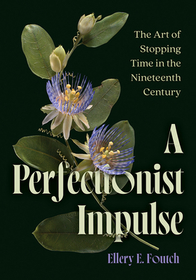
A Perfectionist Impulse
The Art of Stopping Time in the Nineteenth Century
- Publisher's listprice GBP 35.00
-
15 802 Ft (15 050 Ft + 5% VAT)
The price is estimated because at the time of ordering we do not know what conversion rates will apply to HUF / product currency when the book arrives. In case HUF is weaker, the price increases slightly, in case HUF is stronger, the price goes lower slightly.
- Discount 10% (cc. 1 580 Ft off)
- Discounted price 14 222 Ft (13 545 Ft + 5% VAT)
Subcribe now and take benefit of a favourable price.
Subscribe
15 802 Ft

Availability
Not yet published.
Why don't you give exact delivery time?
Delivery time is estimated on our previous experiences. We give estimations only, because we order from outside Hungary, and the delivery time mainly depends on how quickly the publisher supplies the book. Faster or slower deliveries both happen, but we do our best to supply as quickly as possible.
Product details:
- Publisher University Of Minnesota Press
- Date of Publication 30 June 2026
- ISBN 9781517916480
- Binding Paperback
- No. of pages320 pages
- Size 254x178x14 mm
- Weight 481 g
- Language English
- Illustrations 104 black and white illustrations with 23 color plates 700
Categories
Long description:
"
Exploring a collection of wondrous objects to understand the nineteenth-century desire to preserve the perfect moment
Cultural studies of the nineteenth century often categorize their subjects as being motivated by one of two opposing notions: a wholehearted embrace of progress or an antimodernist nostalgia. A Perfectionist Impulse centers a different kind of response to the period's newly intensified awareness of temporality and history: an obsession with preserving perfection. Engaging a diverse set of case studies, Ellery E. Foutch explores the era's desire to forestall the march of time and immortalize the fleeting moment through art and technology.
Beginning with an investigation of artist and naturalist Titian Peale's butterfly illustrations and specimen boxes, Foutch assesses the implications of attempts to fix animal life in the ""perfect state."" She then turns to Harvard's Ware Collection of Glass Flowers, botanical models meticulously crafted to serve as instructional tools but most famous internationally as a spectacle for tourists. Finally, she scrutinizes the period's preoccupation with the fragility of the human body, examining artistic representations of the legendary bodybuilder Eugen Sandow, widely known during his time as the ""Perfect Man."" Highlighting the paradoxical way in which these attempts at preservation ultimately sap the vitality from the organic processes they seek to arrest, Foutch uses these curious objects to unpack a deep set of cultural anxieties around decay and death.
By analyzing objects of mass culture and natural history using methods typically reserved for works of art, A Perfectionist Impulse provides a unique window into how nineteenth-century scientists, technologists, artists, and entertainers rendered a common desire for perfection and immortality. Itself a wondrous collection of attempts to capture the idealized moment, this extensively illustrated book serves as a shining example of our enduring fascination with the ephemeral.
Retail e-book files for this title are screen-reader friendly with images accompanied by short alt text and/or extended descriptions.
" MoreTable of Contents:
Contents
Introduction: A Perfectionist Impulse
1. Arresting the Perfect State: Temporality and Metamorphosis in Titian Peale's Butterfly Works
2. Flowers That Never Fade: Harvard's Glass Flowers
3. Embodying Perfection: The Petrification of Eugen Sandow
Conclusion: The Incompatibility of Perfection and Vitality
Acknowledgments
Notes
Index
More
