

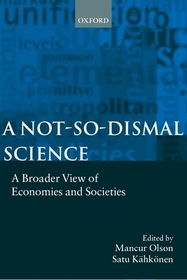
A Not-so-dismal Science
A Broader View of Economies and Societies
- Publisher's listprice GBP 212.50
-
95 943 Ft (91 375 Ft + 5% VAT)
The price is estimated because at the time of ordering we do not know what conversion rates will apply to HUF / product currency when the book arrives. In case HUF is weaker, the price increases slightly, in case HUF is stronger, the price goes lower slightly.
- Discount 10% (cc. 9 594 Ft off)
- Discounted price 86 349 Ft (82 238 Ft + 5% VAT)
Subcribe now and take benefit of a favourable price.
Subscribe
95 943 Ft

Availability
printed on demand
Why don't you give exact delivery time?
Delivery time is estimated on our previous experiences. We give estimations only, because we order from outside Hungary, and the delivery time mainly depends on how quickly the publisher supplies the book. Faster or slower deliveries both happen, but we do our best to supply as quickly as possible.
Product details:
- Publisher OUP Oxford
- Date of Publication 6 January 2000
- ISBN 9780198293699
- Binding Hardback
- No. of pages288 pages
- Size 243x163x21 mm
- Weight 564 g
- Language English
- Illustrations line figures 0
Categories
Short description:
This book shows that, in calling economics the `dismal science', Thomas Carlyle was profoundly wrong. Economic ideas have illuminated behaviour in all of the social sciences in addition to the economists' traditional domain. The broadening of economics and the use of economists' methods by social scientists in other fields is leading to a unified and positive view of economies and societies.
MoreLong description:
Modern economics is like a metropolitan area. Economists' ideas about business and markets are like the magnificent buildings of the city centre. Yet most growth and prosperity is in the suburbs -- lately many of economics' greatest successes have been outside the traditional boundaries of the discipline. In the study of law, economic ideas have been the intellectual focus and `law and economics' has become a major field. In the study of politics, economists and political scientists using economics-type methods are uniquely influential. In sociology and history, economics has had a smaller but growing influence through `rational choice sociology' and `cliometrics'. The influence of the economists type thinking in other social sciences is bringing about a theoretical integration of all the social sciences under one overarching paradigm. The chapters of the book illustrate the intellectual advances that account for this unified view of economies and societies.
Accessible to a wide range of readers.
Table of Contents:
Introduction: The Broader View
Big Bills Left on the Sidewalk: Why Some Nations are Rich and Others Poor
Innovation and its Enemies: The Economic and Political Roots of Technological Inertia
Economic Institutions and Development: A View from the Bottom
Dictatorship, Democracy, and Development
Overstrong against Thyself: War, the State, and Growth in Europe on the Eve of the Industrial Revolution
The Swedish Model: A Comment on Mancur Olson's Analysis
Affirmative Action and Reservations in the American and Indian Labor Markets: Are They Really that Bad?
Communities and Development: Autarkic Social Groups and the Economy
Law from Order: Economic Development and the Jurisprudence of Social Norms
The Nature of Institutional Impediments to Economic Development

