

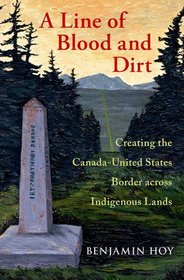
A Line of Blood and Dirt
Creating the Canada-United States Border across Indigenous Lands
- Publisher's listprice GBP 35.49
-
16 023 Ft (15 260 Ft + 5% VAT)
The price is estimated because at the time of ordering we do not know what conversion rates will apply to HUF / product currency when the book arrives. In case HUF is weaker, the price increases slightly, in case HUF is stronger, the price goes lower slightly.
- Discount 20% (cc. 3 205 Ft off)
- Discounted price 12 818 Ft (12 208 Ft + 5% VAT)
- Discount is valid until: 30 June 2026
Subcribe now and take benefit of a favourable price.
Subscribe
16 023 Ft

Availability
Estimated delivery time: In stock at the publisher, but not at Prospero's office. Delivery time approx. 3-5 weeks.
Not in stock at Prospero.
Why don't you give exact delivery time?
Delivery time is estimated on our previous experiences. We give estimations only, because we order from outside Hungary, and the delivery time mainly depends on how quickly the publisher supplies the book. Faster or slower deliveries both happen, but we do our best to supply as quickly as possible.
Product details:
- Publisher OUP USA
- Date of Publication 15 April 2021
- ISBN 9780197528693
- Binding Hardback
- No. of pages344 pages
- Size 236x157x30 mm
- Weight 635 g
- Language English
- Illustrations 22 halftones 96
Categories
Short description:
This book provides a history of the Canada-United States border from 1775 until 1939, highlighting the formation of each nation state, the role Indigenous people had in the development of the international boundary, and the impact the border had on Indigenous people, European settlers, Chinese migrants, and African Americans.
MoreLong description:
The untold history of the multiracial making of the border between Canada and the United States.
Often described as the longest undefended border in the world, the Canada-United States border was born in blood, conflict, and uncertainty. At the end of the American Revolution, Britain and the United States imagined a future for each of their nations that stretched across a continent. They signed treaties with one another dividing lands neither country could map, much less control. A century and a half later, they had largely fulfilled those earlier ambitions. Both countries had built nations that stretched from the Atlantic to the Pacific and had created an expansive international border that restricted movement.
The vision that seemed so clear in the minds of diplomats and politicians was never so well-defined on the ground. As A Line of Blood and Dirt argues, both countries built their border across Indigenous lands using hunger, violence, and coercion to displace existing communities and to disrupt their ideas of territory and belonging. Drawing on oral histories, map visualizations, and archival sources, Benjamin Hoy reveals the role Indigenous people played in the development of the international boundary, as well as the impact the border had on Indigenous people, European settlers, Chinese migrants, and African Americans. Unable to prevent movement at the border's physical location for over a century, Canada and the United States instead found ways to project fear across international lines.
Bringing together the histories of tribes, immigration, economics, and the relationship of neighboring nations, A Line of Blood and Dirt offers a new history of Indigenous peoples and the borderland.
This remarkable examination of the border offers an innovative model for looking at the history of borders beyond the 'line.' It recenters the story of border creation on Indigenous lands and peoples and demonstrates the complex role the latter played in the construction of the border. This approach will help redefine the very questions historians ask about borders, colonialism, and Indigenous and national histories.... Combining private and personal perspectives with government documents, Hoy provides an excellent model for entwining cultural and political histories. The result shows not only what happened but also how people perceived the changes over time....The book is sure to be a boon to readers of all levels: academic, popular, graduate, and undergraduate.
Table of Contents:
Acknowledgments
Terminology
Introduction
Chapter 1 Building Borders
Chapter 2 The Civil and Dakota War
Chapter 3 New Countries, Old Problems
Chapter 4 Borders of Stones, Guns, and Grass
Chapter 5 Where it All Went Wrong
Chapter 6 Borders of Salt and Rock
Chapter 7 Blood and Bones
Chapter 8 The Chaos of Control
Chapter 9 Higher Than Sight Can Reach
Chapter 10 The Borders of Everyday Life
Epilogue
Appendix
Notes
Bibliography
Index

