

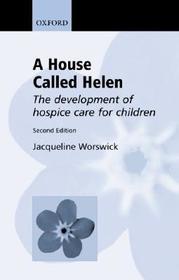
A House Called Helen
The Development of Hospice Care for Children
- Publisher's listprice GBP 51.00
-
23 026 Ft (21 930 Ft + 5% VAT)
The price is estimated because at the time of ordering we do not know what conversion rates will apply to HUF / product currency when the book arrives. In case HUF is weaker, the price increases slightly, in case HUF is stronger, the price goes lower slightly.
- Discount 10% (cc. 2 303 Ft off)
- Discounted price 20 724 Ft (19 737 Ft + 5% VAT)
Subcribe now and take benefit of a favourable price.
Subscribe
23 026 Ft

Availability
printed on demand
Why don't you give exact delivery time?
Delivery time is estimated on our previous experiences. We give estimations only, because we order from outside Hungary, and the delivery time mainly depends on how quickly the publisher supplies the book. Faster or slower deliveries both happen, but we do our best to supply as quickly as possible.
Product details:
- Edition number 2
- Publisher OUP Oxford
- Date of Publication 30 November 2000
- ISBN 9780192632357
- Binding Paperback
- No. of pages268 pages
- Size 216x138x16 mm
- Weight 367 g
- Language English
- Illustrations 36 black and white photographs 0
Categories
Short description:
When the first edition of A House Called Helen was published in 1993, there were only a handful of children's hospices in existence, all of them within the UK. There are now more than twenty in operation, and a significant number at the project stage, in the UK alone, and children's hospices have been set up in Canada, the USA, Australia and continental Europe. The concept of a children's hospice, seen as innovative when the first, Helen House, opened in Oxford in 1982, is now well established and the growth in the number of children's hospices has seen corresponding important developments in the field of paediatric palliative care.
This book provides an authoritative account of how Helen House came into being. It records the events surrounding the foundation of the hospice and how it stemmed directly from what was learnt from the events following the sudden illness of the author's eldest daughter Helen, after whom it was named. The book sets out the philosophy that underpinned the hospice, which was taken up as the guiding philosophy of children's hospice care. It describes the hospice's operational framework and details the service provided by Helen House, which is widely cited as a model for children's hospice care worldwide. It provides valuable insight into the needs of the families who use hospice services and touches both on the difficulties they face caring, often over a long period of time, for a child with a life-limiting illness, and on the role and attitudes of professionals and indeed of the public at large.
In this new edition an additional chapter reviews the growth of children's hospices and reflects on the challenges they face in their maturity. It considers the development of children's hospice care in relation to wider service provision and examines current and future issues surrounding the care of children with life-limiting illness.
"The book will be essential reading for individuals training in the field of palliative care and is important for any professional or lay person involved in the care of seriously ill children." Professor Clifford C. Bailey, Consultant Paediatric Oncologist, United Leeds Teaching Hospitals Trust and Director of Research and Development, NHS Executive, Northern and Yorkshire, UK
Long description:
When the first edition of A House Called Helen was published in 1993, there were only a handful of children's hospices in existence, all of them within the UK. There are now more than twenty in operation, and a significant number at the project stage, in the UK alone, and children's hospices have been set up in Canada, the USA, Australia and continental Europe. The concept of a children's hospice, seen as innovative when the first, Helen House, opened in Oxford in 1982, is now well established and the growth in the number of children's hospices has seen corresponding important developments in the field of paediatric palliative care.
This book provides an authoritative account of how Helen House came into being. It records the events surrounding the foundation of the hospice and how it stemmed directly from what was learnt from the events following the sudden illness of the author's eldest daughter Helen, after whom it was named. The book sets out the philosophy which underpinned the hospice, which was taken up as the guiding philosophy of children's hospice care. It describes the hospice's operational framework and details the service provided by Helen House, which is widely cited as a model for children's hospice care worldwide. It provides valuable insight into the needs of the families who use hospice services and touches both on the difficulties they face caring, often over a long period of time, for a child with a life-limiting illness, and on the role and attitudes of professionals and indeed of the public at large.
In this new edition an additional chapter reviews the growth of children's hospices and reflects on the challenges they face in their maturity. It considers the development of children's hospice care in relation to wider service provision and examines current and future issues surrounding the care of children with life-limiting illness.
Will be of interest to anyone involved in paediatric palliative care.
Table of Contents:
Introduction
Helen's illness
Home from hospital
Frances and Helen
Planning the hospice
The vision becomes reality
After the opening
The philosophy at work
Reflections on years of caring
Conclusion
Into the new millennium

