

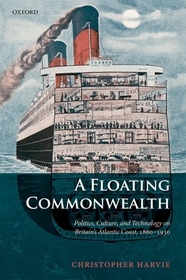
A Floating Commonwealth
Politics, Culture, and Technology on Britain's Atlantic Coast, 1860-1930
- Publisher's listprice GBP 41.99
-
18 958 Ft (18 055 Ft + 5% VAT)
The price is estimated because at the time of ordering we do not know what conversion rates will apply to HUF / product currency when the book arrives. In case HUF is weaker, the price increases slightly, in case HUF is stronger, the price goes lower slightly.
- Discount 10% (cc. 1 896 Ft off)
- Discounted price 17 062 Ft (16 250 Ft + 5% VAT)
Subcribe now and take benefit of a favourable price.
Subscribe
18 958 Ft

Availability
printed on demand
Why don't you give exact delivery time?
Delivery time is estimated on our previous experiences. We give estimations only, because we order from outside Hungary, and the delivery time mainly depends on how quickly the publisher supplies the book. Faster or slower deliveries both happen, but we do our best to supply as quickly as possible.
Product details:
- Publisher OUP Oxford
- Date of Publication 10 May 2012
- ISBN 9780199655182
- Binding Paperback
- No. of pages336 pages
- Size 234x155x19 mm
- Weight 524 g
- Language English
- Illustrations 10 black and white images 0
Categories
Short description:
This is a new portrait of society and identity in high industrial Britain, focusing on the sea as connector, not barrier. It argues that the port cities and their hinterlands formed a 'floating commonwealth' whose interaction with one another and with nationalist and imperial politics created an intense political and cultural synergy.
MoreLong description:
Christopher Harvie offers a new portrait of society and identity in high industrial Britain by focusing on the sea as connector, not barrier. Atlantic and 'inland sea' together, Harvie argues, created a 'floating commonwealth' of port cities and their hinterlands whose interaction, both with one another and with nationalist and imperial politics, created an intense political and cultural synergy.
At a technical level, this produced the freight steamer and the efficient types of railways which opened up the developing world, as well as the institutions of international finance and communications in the age of 'telegrams and anger'. And ultimately, the resources of the Atlantic cities, their shipyards and works, enabled Britain to win withstand the test of the First World War.
Meanwhile, as Harvie shows, the continuous attempt to make sense of an ever-changing material reality also stimulated the discourses on which social criticism and literary modernism were based, from Carlyle to James Joyce - although the ultimate outcome, of slump and emigration, would leave enduring problems in the years to come.
Review from previous edition Harvie is especially good at selecting an economic or artistic personality, and using his furiously allusive scholarship to place them at the heart of historical change.
Table of Contents:
Prelude: Behold The Sea!
'Behold The Sea!'
'The Writing and Acting of History'
The Atlantic Moment
Perspectives
Nationalizing History
Basins
Covenants
Mediations
'L'Invitation au Voyage'
I Places and Voices
Sacred Lambencies and Thin Crusts: Culture, Danger and Industry
Natura Maligna
A Patriot for Whom?
Auld Scotia - Who She?
'A Thin Crust'
Enlightenment and Uncertainty
Galatea
I.2 Garron Top To Westward Ho!: The Inland Sea
The Irish Boat
A Country the Poets have Imagined
'The Antechamber of Britain'
Money and Migrants
'Traffics and Discoveries'
'But Westward look!'
Civic Empires
I.3 McAndrew: The Engineer on the Celtic Fringe
'The Forgiving of the Anchor'
The Uses of Rhetoric
Breakthrough
ves of the Engineers'
'Work and Question not'
Prussians and Asiatics
II Ourselves Together
II.1 Anglo-Saxons into Celts: The Scottish Intellectuals
Enlightenment and Deception
An Infinite Religious Idea
Revivals
Geddes and Synergy
'The Genius of the Gael'
II.2 The Folk and the Gwerin: Religious Democracy in Scotland and Wales
The Persistence of Faith
State, Religion, People
'Godly Commonwealths'
Religious Rebels
The People's William
Legacies
Schools and Schoolmasters
II.3 Contrary Heroes: Industry, Ethnie, and Ireland
Measuring Distances: Ireland, Industry, and Theory
'Creative Chaos', Victims and Gastarbeiter
Machines and Heroes
Carlyle and Ireland: Positivist-Protestant
Carlyle and Ireland: Celtic-Catholic
The Ultramontane Opportunity
Where were the Hero-Sisters?
Hidden Ireland or Plain People?
III In Time of the Breaking of Nations
III.1 Muscular Celticism: Sport and Nationalism
Sport and Statehood
Homo Ludens
Sport and Sociologists
The Civic Mode
To the Tailteann Games
Spieltrieb: a Diversion?
III.2 John Bull's Other Irishman: Shaw, Geddes, and the Geotechnic Movement
The View from Baker Street
The Intelligent Fabian's West Britain
The Road to Rosscullen
Earthquake
Passionate Dreaming
'Order the guns and kill!'
III.3 Men Who Pushed and Went: West Coast Capitalism, War and Nationalism
Frontism and Remembrance
Expectations, Actualities, the Wizard: August 1914-April 1916
'The Workshops are our Battlefield'
From Reconstruction to Victory
The University of Frongoch: Ireland Escapes
IV Aftermath
'Night's Candles Are Burned Out'
Dynamic Forces
Into the Doldrums
'A General Unsettlement'
Inquests
After Ireland
American Dreams
Nationalism Redux
The Big Ship Goes Down
Episodes, Epiphanies, Imperium?
The 'O' on Olympian
Prelude: Behold The Sea!
'Behold The Sea!'
'The Writing and Acting of History'
The Atlantic Moment
Perspectives
Nationalizing History
Basins
Covenants
Mediations
'L'Invitation au Voyage'
I Places and Voices
I.1 Sacred Lambencies and Thin Crusts: Culture, Danger and Industry
Natura Maligna
A Patriot for Whom?
Auld Scotia - Who She?
'A Thin Crust'
Enlightenment and Uncertainty
Galatea
I.2 Garron Top To Westward Ho!: The Inland Sea
The Irish Boat
A Country the Poets have Imagined
'The Antechamber of Britain'
Money and Migrants
'Traffics and Discoveries'
'But Westward look!'
Civic Empires
I.3 McAndrew: The Engineer on the Celtic Fringe
'The Forgiving of the Anchor'
The Uses of Rhetoric
Breakthrough
'Lives of the Engineers'
'Work and Question not'
Prussians and Asiatics
II Ourselves Together
II.1 Anglo-Saxons into Celts: The Scottish Intellectuals
Enlightenment and Deception
An Infinite Religious Idea
Revivals
Geddes and Synergy
'The Genius of the Gael'
II.2 The Folk and the Gwerin: Religious Democracy in Scotland and Wales
The Persistence of Faith
State, Religion, People
'Godly Commonwealths'
Religious Rebels
The People's William
Legacies
Schools and Schoolmasters
II.3 Contrary Heroes: Industry, Ethnie, and Ireland
Measuring Distances: Ireland, Industry and Theory
'Creative Chaos', Victims and Gastarbeiter
Machines and Heroes
Carlyle and Ireland: Positivist-Protestant
Carlyle and Ireland: Celtic-Catholic
The Ultramontane Opportunity
Where were the Hero-Sisters?
Hidden Ireland or Plain People?
III In Time of the Breaking of Nations
III.1 Muscular Celticism: Sport and Nationalism
Sport and Statehood
Homo Ludens
Sport and Sociologists
The Civic Mode
To the Tailteann Games
Spieltrieb: a Diversion?
III.2 John Bull's Other Irishman: Shaw, Geddes, and the Geotechnic Movement
The View from Baker Street
The Intelligent Fabian's West Britain
The Road to Rosscullen
Earthquake
Passionate Dreaming
'Order the guns and kill!'
III.3 Men Who Pushed and Went: West Coast Capitalism, War and Nationalism
Frontism and Remembrance
Expectations, Actualities, the Wizard: August 1914-April 1916
'The Workshops are our Battlefield'
From Reconstruction to Victory
The University of Frongoch: Ireland escapes
IV Aftermath
'Night's Candles Are Burned Out'
Dynamic Forces
Into the Doldrums
'A General Unsettlement'
Inquests
After Ireland
American Dreams
Nationalism Redux
The Big Ship Goes Down
Episodes, Epiphanies, Imperium?
The O' on Olympian

