

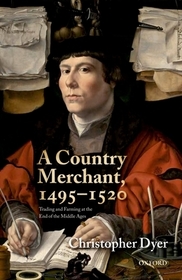
A Country Merchant, 1495-1520
Trading and Farming at the End of the Middle Ages
- Publisher's listprice GBP 170.00
-
76 755 Ft (73 100 Ft + 5% VAT)
The price is estimated because at the time of ordering we do not know what conversion rates will apply to HUF / product currency when the book arrives. In case HUF is weaker, the price increases slightly, in case HUF is stronger, the price goes lower slightly.
- Discount 10% (cc. 7 676 Ft off)
- Discounted price 69 080 Ft (65 790 Ft + 5% VAT)
Subcribe now and take benefit of a favourable price.
Subscribe
76 755 Ft

Availability
printed on demand
Why don't you give exact delivery time?
Delivery time is estimated on our previous experiences. We give estimations only, because we order from outside Hungary, and the delivery time mainly depends on how quickly the publisher supplies the book. Faster or slower deliveries both happen, but we do our best to supply as quickly as possible.
Product details:
- Publisher OUP Oxford
- Date of Publication 17 May 2012
- ISBN 9780199214242
- Binding Hardback
- No. of pages272 pages
- Size 241x164x20 mm
- Weight 626 g
- Language English
- Illustrations 30 black and white images 0
Categories
Short description:
A major contribution to the economic and social history of a mysterious period, the years around 1500, using new evidence and methods of analysis. Presents a fresh and engaging view of history by highlighting an individual, John Heritage.
MoreLong description:
Around 1500 England's society and economy had reached a turning point. After a long period of slow change and even stagnation, an age of innovation and initiative was in motion, with enclosure, voyages of discovery, and new technologies. It was an age of fierce controversy, in which the government was fearful of beggars and wary of rebellions. The 'commonwealth' writers such as Thomas More were sharply critical of the greed of profit hungry landlords who dispossessed the poor. This book is about a wool merchant and large scale farmer who epitomises in many ways the spirit of the period. John Heritage kept an account book, from which we can reconstruct a whole society in the vicinity of Moreton in Marsh, Gloucestershire. He took part in the removal of a village which stood in the way of agricultural 'improvement', ran a large scale sheep farm, and as a 'woolman' spent much time travelling around the countryside meeting with gentry, farmers, and peasants in order to buy their wool. He sold the wool he produced himself, and the fleeces he gathered, to London merchants who exported wool through Calais to the textile towns of Flanders. The wool growers named in the book can be studied in their native villages, and their lives can be reconstructed in the round, interacting in their communities, adapting their farming to new circumstances, and arranging the building of their local churches.
A Country Merchant has some of the characteristics of a biography, is part family history and part local history, with some landscape history. Dyer explores themes in economic and social history without neglecting the religious and cultural background. His central concern is to demonstrate the importance of the peasants' contribution to a changing economy.
[A] rich work ... greatly enhances our appreciation of the more dynamic elements typical of the period.
Table of Contents:
Introduction: Living in 1495-1520
Family and household: John Heritage and his Contemporaries
John Heritage's Country
John Heritage's Wool Business
Pasture, Sheep, Wool, and People
Beyond the Account Book: Changing the Countryside
Individuals and Communities
Conclusion
Appendix 1: Sample pages from the account book
Appendix 2: Deserted village sites
Bibliography
Index

