

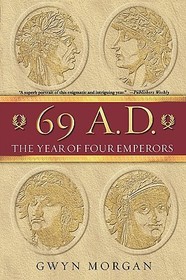
69 A.D.
The Year of Four Emperors
- Publisher's listprice GBP 15.99
-
7 219 Ft (6 875 Ft + 5% VAT)
The price is estimated because at the time of ordering we do not know what conversion rates will apply to HUF / product currency when the book arrives. In case HUF is weaker, the price increases slightly, in case HUF is stronger, the price goes lower slightly.
- Discount 10% (cc. 722 Ft off)
- Discounted price 6 497 Ft (6 188 Ft + 5% VAT)
Subcribe now and take benefit of a favourable price.
Subscribe
7 219 Ft

Availability
printed on demand
Why don't you give exact delivery time?
Delivery time is estimated on our previous experiences. We give estimations only, because we order from outside Hungary, and the delivery time mainly depends on how quickly the publisher supplies the book. Faster or slower deliveries both happen, but we do our best to supply as quickly as possible.
Product details:
- Edition number New ed
- Publisher OUP USA
- Date of Publication 22 March 2007
- ISBN 9780195315899
- Binding Paperback
- No. of pages336 pages
- Size 235x156x21 mm
- Weight 476 g
- Language English
- Illustrations 4 maps 0
Categories
Short description:
The year following the Nero in June 68, so the ancient sources assure us, was one of the most chaotic, violent and frightening periods in all Roman history: a time of assassinations and civil wars, of armies so out of control that they had no qualms about occupying the city of Rome, and of ambitious men who seized power only to lose it, one after another.
^ Gwyn Morgan offers a fresh look at this period, based on two considerations to which insufficient attention has been paid in the past. First, that we need to unravel rather than cherry-pick between the conflicting accounts of Tacitus, Plutarch and Suetonius, our three main sources of information. And second, that the role of the armies, as distinct from that of their commanders, has too often been exaggerated. The result is an accurate and insightful narrative history, filled with colourful portraits of the leading participants and new insights into the nature of the Roman military.
Long description:
The Year of Four Emperors, so the ancient sources assure us, was one of the most chaotic, violent and frightening periods in all Roman history: a time of assassinations and civil wars, of armies so out of control that they had no qualms about occupying the city of Rome, and of ambitious men who seized power only to lose it, one after another.
In 69 AD, Gwyn Morgan offers a fresh look at this period, based on two considerations to which insufficient attention has been paid in the past. First, that we need to unravel rather than cherry-pick between the conflicting accounts of Tacitus, Plutarch and Suetonius, our three main sources of information. And second, that the role of the armies, as distinct from that of their commanders, has too often been exaggerated. The result is a remarkably accurate and insightful narrative history, filled with colorful portraits of the leading participants and new insights into the nature of the Roman military. Morgan ranges from the suicide of Nero in June 68 to the triumph of Vespasian in December 69. In between, three other emperors hold power. We meet Galba, old, tightfisted and conservative, who was declared emperor in June 68 and assassinated in January 69. Otho, once Nero's boon companion, who was responsible for murdering Galba, seized power in a coup in Rome in January 69 and, to everybody's surprise, committed suicide three months later in a vain attempt to end the civil wars. Vitellius, as indolent as he was extravagant, who was put forward by two ambitious lieutenants, recognized by the senate in Rome once they heard of Otho's death in April, and cut down by Vespasian's partisans in the last days of December. And then there is Vespasian, the candidate who looked least likely to succeed, but (according to Tacitus) was the first to be improved by becoming emperor.
A strikingly vivid history of ancient Rome, 69 AD is an original and compelling account of one of the best known but perhaps least understood periods in all Roman history.
A superb portrait of this enigmatic and intriguing year.

