

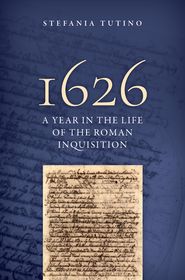
1626
A Year in the Life of the Roman Inquisition
- Publisher's listprice GBP 86.00
-
38 829 Ft (36 980 Ft + 5% VAT)
The price is estimated because at the time of ordering we do not know what conversion rates will apply to HUF / product currency when the book arrives. In case HUF is weaker, the price increases slightly, in case HUF is stronger, the price goes lower slightly.
- Discount 10% (cc. 3 883 Ft off)
- Discounted price 34 946 Ft (33 282 Ft + 5% VAT)
Subcribe now and take benefit of a favourable price.
Subscribe
38 829 Ft

Availability
Estimated delivery time: In stock at the publisher, but not at Prospero's office. Delivery time approx. 3-5 weeks.
Not in stock at Prospero.
Why don't you give exact delivery time?
Delivery time is estimated on our previous experiences. We give estimations only, because we order from outside Hungary, and the delivery time mainly depends on how quickly the publisher supplies the book. Faster or slower deliveries both happen, but we do our best to supply as quickly as possible.
Product details:
- Publisher OUP USA
- Date of Publication 18 August 2025
- ISBN 9780197806852
- Binding Hardback
- No. of pages448 pages
- Size 237x169x33 mm
- Weight 807 g
- Language English 630
Categories
Short description:
Drawing on an extraordinarily large body of hitherto unexamined archival material, this book reconstructs all the activities of the Roman Inquisition in the year 1626.
MoreLong description:
In 1626, Europe was in the midst of the Thirty Years' War; a flu pandemic began spreading in Asia; the Dutch acquired the island of Manhattan; Queen Christina of Sweden was born; and Francis Bacon died. A lot can happen in a year, and 1626 was no exception. It was an exceptional year for the Roman Inquisition, however, but not because of anything that happened. What makes it exceptional is that an extraordinarily large body of archival material from that year has been preserved. Drawing on this hitherto unexamined material, Stefania Tutino reconstructs all the activities of the Roman Inquisition in the year 1626.
This book demonstrates that the early-seventeenth-century Roman Inquisition was not solely the expression of the most militant and repressive aspects of post-Reformation Catholicism. Rather, to understand the historical role the Holy Office played, we need to see its development in terms of the tension between rigidity on the one hand and flexibility and complexity on the other. Having the opportunity to see all the activities of the Holy Office in one entire year makes the centrality of this tension easier to appreciate than if we just focused on a specific and necessarily limited subset of issues such as witchcraft or book censorship. Conversely, the granular analysis of those activities provided in this book is necessary to get a concrete sense of all the ways in which this tension manifested.
The strength of the Roman Inquisition in 1626 -and simultaneously the reason for its downfall in the long run-is that an institution that thrives on rigidity and whose core mission is to maintain inflexible boundaries between the one true faith and all deviations is intrinsically unable to deal with complexity, mobility, and fluidity. All those factors rendered the imposition of stringent norms increasingly difficult and ultimately impossible. The Holy Office tried to keep up, but the complexity of the world that Roman Inquisitors presumed to oversee overwhelmed the intrinsic rigidity of their mandate.
Table of Contents:
Introduction
Facts and Figures
Cases: Internal Affairs
Cases: Money
Cases: Sex
Cases: Doctrine I
Cases: Doctrine II
Cases: Ecclesiology and Politics
Cases: Setting and Crossing Boundaries
Decisions
Conclusion

