

-
GET 10% OFF
- Publisher's listprice GBP 155.00
-
69 982 Ft (66 650 Ft + 5% VAT)
The price is estimated because at the time of ordering we do not know what conversion rates will apply to HUF / product currency when the book arrives. In case HUF is weaker, the price increases slightly, in case HUF is stronger, the price goes lower slightly.
- Discount 10% (cc. 6 998 Ft off)
- Discounted price 62 984 Ft (59 985 Ft + 5% VAT)
62 984 Ft

Availability
Not yet published.
Why don't you give exact delivery time?
Delivery time is estimated on our previous experiences. We give estimations only, because we order from outside Hungary, and the delivery time mainly depends on how quickly the publisher supplies the book. Faster or slower deliveries both happen, but we do our best to supply as quickly as possible.
Product details:
- Edition number 1
- Publisher Routledge
- Date of Publication 21 September 2026
- ISBN 9781041390848
- Binding Hardback
- No. of pages162 pages
- Size 246x174 mm
- Language English 0
Categories
Short description:
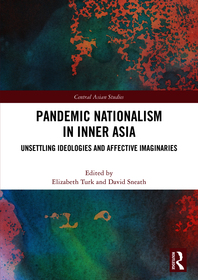
This book offers an ethnographic analysis of nationalist thought, centralized power, and modes of governance in (post-)pandemic Mongolian political and cultural contexts.
More
Long description:
This book offers an ethnographic analysis of nationalist thought, centralized power, and modes of governance in (post-)pandemic Mongolian political and cultural contexts. By reframing the unity often associated with descriptive ‘groupist’ thought in terms of claims and objects of concern within a wider political imaginary, this book provides a new conceptual framework for understanding nationalist thought beyond the strictly ideological.
By approaching nationalism as a structure of ideas formed within a wider affective imaginary of human groupings and attachments, the book draws attention to the diversity such claims can take. Through the lens of nationalism as a narrative, the book explores how claims and objects of concern—such as the notion of a national ‘people’ or ethnicity—interact with processes of ideational authorship, messaging, and reception. It examines how affect is enacted as part of ideational encounters, relocating it from an ontological or subconscious force to a historically situated and authored outcome of human engagement. Drawing on rich ethnographic insights from across the Mongolian region, the book presents a novel methodology for theorizing nationalism that emphasizes objects of concern and ethnographic particularities.
Pandemic Nationalism in Inner Asia is designed for scholars, researchers, and students in anthropology, political science, sociology, and Asian studies. It will also appeal to those interested in nationalism, governance, and the cultural impacts of pandemics. Broad subject areas include ethnography, nationalism studies, affect theory, and Inner Asian studies.
The chapters in this book were originally published as a special issue of Central Asian Survey.
MoreTable of Contents:
Introduction: Nationalist imaginaries and the COVID pandemic in inner Asia: notes towards an analytic methodology 1. The Mongolian state and the coronavirus pandemic: policy, messaging and the nationalist imaginary 2. Iterations from the past: a no-nonsense approach to the importers of the virus during the COVID-19 pandemic in Mongolia 3. Traditional medicine, legitimacy and nationalist doxa in pandemic-era Mongolia 4. The crisis-events and reassembled ethnolinguistic-cum-environmentalist subjects in Inner Mongolia 5. Reclaiming self-esteem: Mongols’ responses to the early COVID-19 pandemic in Inner Mongolia, China 6. Kinship imaginaries of similarity and difference: gifts from Inner Mongols to Mongolia during the COVID-19 pandemic
More

