

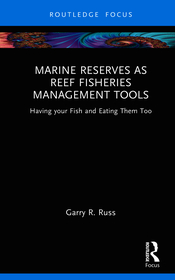
Marine Reserves as Reef Fisheries Management Tools
Having your Fish and Eating Them Too
Series: Earthscan Oceans;
-
GET 10% OFF
- Publisher's listprice GBP 55.99
-
25 279 Ft (24 075 Ft + 5% VAT)
The price is estimated because at the time of ordering we do not know what conversion rates will apply to HUF / product currency when the book arrives. In case HUF is weaker, the price increases slightly, in case HUF is stronger, the price goes lower slightly.
- Discount 10% (cc. 2 528 Ft off)
- Discounted price 22 751 Ft (21 668 Ft + 5% VAT)
22 751 Ft

Availability
Not yet published.
Why don't you give exact delivery time?
Delivery time is estimated on our previous experiences. We give estimations only, because we order from outside Hungary, and the delivery time mainly depends on how quickly the publisher supplies the book. Faster or slower deliveries both happen, but we do our best to supply as quickly as possible.
Product details:
- Edition number 1
- Publisher Routledge
- Date of Publication 31 August 2026
- ISBN 9781041356578
- Binding Hardback
- No. of pages156 pages
- Size 216x138 mm
- Language English
- Illustrations 23 Illustrations, black & white; 8 Halftones, black & white; 15 Line drawings, black & white; 2 Tables, black & white 700
Categories
Short description:
This book showcases how marine reserves, when implemented and protected effectively, could simultaneously achieve conservation and reef fishery goals.
Long description:
This book showcases how marine reserves, when implemented and protected effectively, could simultaneously achieve conservation and reef fishery goals.
Marine reserves, permanent spatial closures to fishing, are often viewed as detrimental to fisheries, reducing the area available for fishing and concentrating effort into smaller areas. But what if these reserves could supplement reef fisheries? Drawing on over forty years of research and teaching experience, the author explores the concept of net export?where reserves produce such abundant fish biomass that they spill over into fished areas, partly compensating for the loss of fishing grounds. The book delves into recent advancements in larval tagging and tracking, showcasing studies from the Great Barrier Reef, Papua New Guinea, and beyond, to demonstrate how recruitment subsidy, net export of fish larvae from reserves to fished areas, combined with reductions in fishery effort outside reserves when reserves are implemented, can lead to sustainable reef fisheries alongside conservation. The book argues that with the right balance between conservation and catch, marine reserves can achieve a ?win-win? scenario, ensuring both healthy fish populations and sustainable reef fisheries. This book calls for conservation and fisheries to co-ordinate, not confront, in order to simultaneously achieve their objectives.?
Written in clear and accessible language, this book is essential reading for marine conservation and fisheries professionals and policymakers, as well as students and scholars of marine science and conservation.
MoreTable of Contents:
'1. Introduction.? 2. Marine Reserves as Reef Fisheries Management Tools: Expectations.? 3. Modelling Effects of Marine Reserves on Fisheries Catch.? 4. Recovery of Target Species.? 5. Spillover.? 6. Recruitment Subsidy.? 7. Getting the Best Balance Between Catch and Conservation Objectives.??
More
