

- Publisher's listprice GBP 37.99
-
17 152 Ft (16 335 Ft + 5% VAT)
The price is estimated because at the time of ordering we do not know what conversion rates will apply to HUF / product currency when the book arrives. In case HUF is weaker, the price increases slightly, in case HUF is stronger, the price goes lower slightly.
- Discount 20% (cc. 3 430 Ft off)
- Discounted price 13 721 Ft (13 068 Ft + 5% VAT)
- Discount is valid until: 30 June 2026
Subcribe now and take benefit of a favourable price.
Subscribe
15 437 Ft

Availability
Not yet published.
Why don't you give exact delivery time?
Delivery time is estimated on our previous experiences. We give estimations only, because we order from outside Hungary, and the delivery time mainly depends on how quickly the publisher supplies the book. Faster or slower deliveries both happen, but we do our best to supply as quickly as possible.
Product details:
- Edition number 1
- Publisher Routledge
- Date of Publication 20 July 2026
- ISBN 9781032798479
- Binding Paperback
- No. of pages368 pages
- Size 234x156 mm
- Language English
- Illustrations 15 Illustrations, black & white; 15 Line drawings, black & white; 10 Tables, black & white 700
Categories
Short description:
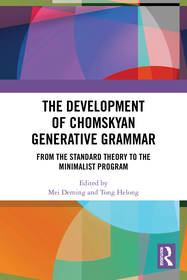
This book explores the major theories of generative grammar from a historical perspective, providing an overview and tracing the evolution of this linguistic framework.
MoreLong description:
This book explores the major theories of generative grammar from a historical perspective, providing an overview of the evolution of this linguistic framework.
Generative grammar is widely recognized for its major contributions to the study of theoretical linguistics in the twentieth century and has had a profound impact on the fields of linguistics, psychology, computer science, and cognitive science. This book consists of eight chapters that trace the development of generative grammar from its beginnings to its current focus on minimalism. The first chapter outlines the major stages of generative grammar, namely Classical Theory, Standard Theory, Extended Standard Theory, Revised Extended Standard Theory, Government and Binding Theory, and the Minimalist Program. The second chapter reviews the development of the C‑command relation and illustrates its use in syntactic analysis. Each of the following six chapters focuses on a specific area of generative grammar, including phrase structure, movement, Case, argument structure, binding, and raising and control.
The volume will be an invaluable resource for researchers, teachers, and students in the fields of generative grammar, syntax, formal linguistics, and the social and cognitive sciences.
MoreTable of Contents:
1. The Development of the Architecture of Grammar 2. The Development of C-command and Related Concepts 3. The Development of Phrase Structure 4. The Development of Movement Theory 5. The Development of Case Theory 6. The Development of the Theory of Argument Structure 7. The Development of Binding Theory 8. The Development of Raising and Control
More

