

- Publisher's listprice GBP 45.99
-
20 764 Ft (19 775 Ft + 5% VAT)
The price is estimated because at the time of ordering we do not know what conversion rates will apply to HUF / product currency when the book arrives. In case HUF is weaker, the price increases slightly, in case HUF is stronger, the price goes lower slightly.
- Discount 20% (cc. 4 153 Ft off)
- Discounted price 16 611 Ft (15 820 Ft + 5% VAT)
- Discount is valid until: 30 June 2026
Subcribe now and take benefit of a favourable price.
Subscribe
18 687 Ft

Availability
Not yet published.
Why don't you give exact delivery time?
Delivery time is estimated on our previous experiences. We give estimations only, because we order from outside Hungary, and the delivery time mainly depends on how quickly the publisher supplies the book. Faster or slower deliveries both happen, but we do our best to supply as quickly as possible.
Product details:
- Edition number 1
- Publisher Routledge
- Date of Publication 20 July 2026
- ISBN 9781032739267
- Binding Paperback
- No. of pages206 pages
- Size 234x156 mm
- Language English
- Illustrations 6 Illustrations, black & white; 6 Line drawings, black & white; 12 Tables, black & white 700
Categories
Short description:
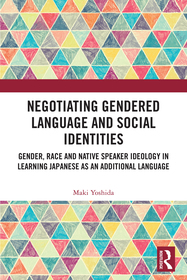
This book explores gendered language and gender identities negotiated by seven tertiary students of Japanese as an additional language (JAL) in Australia.
MoreLong description:
This book explores gendered language and gender identities negotiated by seven tertiary students of Japanese as an additional language (JAL) in Australia. It demonstrates that while participants are familiar with gendered Japanese as linguistic resources, their self- positioned and ascribed ‘learnersness’, ‘nonnative-speakerness’ and ‘non- Japaneseness’ both inside and outside classroom contexts greatly impact the targeted negotiations. It argues that these ascribed social identities encourage participants to adopt ‘correct’ (gendered) Japanese; however, what exactly this ‘correctness’ means differs for each JAL participant, depending on their other reflective and perceived social identities—such as gender, age, class, race and English ‘native- speakerness’.
This book draws on the conclusions on the implications of discourses and practices concerning native- speaker status, gender and race in Japanese language education. While the initial focus is on gendered Japanese and gender identity, this book subsequently expands that the participants’ negotiation of gendered Japanese and gender identity is complicatedly intertwined with negotiations of other social identities such as native- speaker status, race and age, with native-speaker status saliently affecting the way they position themselves and are positioned by their interlocutors. This book analyses the participants’ language resources, spoken and/ or written Japanese interactions and one-on-one and focus- group interviews and presents easily understood findings for readers who are interested in SLA, Japanese, language and/ or identity studies.
This is the first book to holistically examine Australia- based tertiary students’ Japanese language learning experience and Japanese interactions with regards to (gendered) language, identities and discursive power relations in a global and multilingual world.
MoreTable of Contents:
1 Introduction 2 Gendered Japanese, Gender Identities and Gender Ideologies: Learning Japanese in the Time of Globalisation and Accelerated Unequal Power Relations 3 JAL Participants’ Negotiation of Gendered Language and Gender Identities 4 Language and Gender Ideologies and ‘Learners of Japanese’ 5 JAL Participants’ Social Identities and Discursive Power Relations—Intersections of ‘Nativeness’, ‘Gender’, ‘Class’, ‘Age’ and ‘Race’ 6 Conclusion Appendix 1: Details of pre-recorded interaction Appendix 2: Questions for JAL participants’ diary entry Appendix 3: Template of questionnaire Appendix 4: Gendered linguistic features used as stimuli in one-on-one semi-structured interviews Appendix 5: Conventions employed for the transcriptions in the current study
More
