

-
GET 10% OFF
- Publisher's listprice GBP 155.00
-
69 982 Ft (66 650 Ft + 5% VAT)
The price is estimated because at the time of ordering we do not know what conversion rates will apply to HUF / product currency when the book arrives. In case HUF is weaker, the price increases slightly, in case HUF is stronger, the price goes lower slightly.
- Discount 10% (cc. 6 998 Ft off)
- Discounted price 62 984 Ft (59 985 Ft + 5% VAT)
62 984 Ft

Availability
Estimated delivery time: In stock at the publisher, but not at Prospero's office. Delivery time approx. 3-5 weeks.
Not in stock at Prospero.
Why don't you give exact delivery time?
Delivery time is estimated on our previous experiences. We give estimations only, because we order from outside Hungary, and the delivery time mainly depends on how quickly the publisher supplies the book. Faster or slower deliveries both happen, but we do our best to supply as quickly as possible.
Product details:
- Edition number 1
- Publisher Routledge
- Date of Publication 12 April 2026
- ISBN 9781032427249
- Binding Hardback
- No. of pages198 pages
- Size 229x152 mm
- Weight 530 g
- Language English
- Illustrations 4 Illustrations, black & white; 2 Halftones, black & white; 2 Line drawings, black & white; 1 Tables, black & white 695
Categories
Short description:
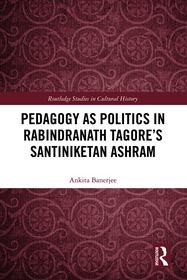
This book demonstrates that Rabindranath Tagore, the poet-educator, was an intensely political figure with a distinctive vision of politics.
MoreLong description:
This book demonstrates that Rabindranath Tagore, the poet-educator, was an intensely political figure with a distinctive vision of politics.
Its innovative approach treats the educational pedagogy of Tagore practised at his ashram in Santiniketan as the most eloquent expression of his political will. In doing so, it identifies three key ideas, swadeshbhakti, mukti, and manush, as the pillars of his political vision. Using a combination of conceptual and textual analysis, this book explores a wealth of archival sources—manuscripts, letters, journals, newspapers, and magazines—as well as Tagore’s rich body of work.
The hitherto untold story of Tagore’s Santiniketan ashram vis-à-vis the political landscape of twentieth-century India will make this book particularly interesting to Tagore scholars, but it will also be of interest to scholars of South Asian history and global conceptual history, as well those in undergraduate and postgraduate studies looking to familiarise themselves with the history of twentieth-century India.
MoreTable of Contents:
Introduction; 1. Tagore’s ideas on education: Comparing Santiniketan ashram with the Kanya Mahavidyalay and The Dawn Society; 2. Santiniketan ashram’s political context: Swadeshi Bengal of the early twentieth century Tagore’s political context; 3. Dharmashiksha and swadeshbhakti at the Santiniketan ashram; 4. Mukti versus swaraj: Freedom at the Santiniketan ashram; 5. Conquering ethnic identities: Manush as Tagore’s notion of unique individuals at the Santiniketan ashram; Concluding Remarks; Bibliography; Index
More
