

- Publisher's listprice GBP 90.00
-
40 635 Ft (38 700 Ft + 5% VAT)
The price is estimated because at the time of ordering we do not know what conversion rates will apply to HUF / product currency when the book arrives. In case HUF is weaker, the price increases slightly, in case HUF is stronger, the price goes lower slightly.
- Discount % (cc. 0 Ft off)
- Discounted price 0 Ft (0 Ft + 5% VAT)
Subcribe now and take benefit of a favourable price.
Subscribe
40 635 Ft

Availability
Not yet published.
Why don't you give exact delivery time?
Delivery time is estimated on our previous experiences. We give estimations only, because we order from outside Hungary, and the delivery time mainly depends on how quickly the publisher supplies the book. Faster or slower deliveries both happen, but we do our best to supply as quickly as possible.
Product details:
- Publisher Cambridge University Press
- Date of Publication 31 August 2026
- ISBN 9781009544405
- Binding Hardback
- No. of pages323 pages
- Language English 0
Categories
Short description:
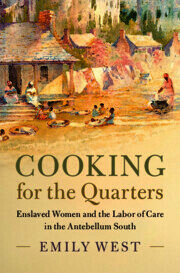
A compelling look at the work of enslaved women forced to prepare food for the enslaved, rather than enslavers.
MoreLong description:
Women who prepared food for enslaved people, rather than enslavers, have been neglected in historical scholarship. Their labor within the quarters has been marginalized, belittled, and even ignored, because it fell within the remit of gendered care and nurture. In this book, Emily West illustrates how these mostly older women performed vital roles in slaveholding sites, as their enslavers increasingly tried to regulate food distribution, preparation, and consumption. Enslavers attempted to impose highly efficient, communal food regimes to minimize waste and time lost from work elsewhere. They routinely tasked older women with the feeding and care of infants, but also deployed them to prepare food for children and enslaved adults to eat collectively. Conversely, in the relative privacy of the quarters, where enslaved people preferred to eat, cooking became both a form of gendered exploitation, and an expression of love, empowerment, and pleasure.
MoreTable of Contents:
Introduction; 1. Enslaved women and infant care; 2. Enslaved women and wetnursing; 3. Enslaved women and the feeding of children; 4. Collective eating regimes and enslaved adults; 5. Cooking and eating within the quarters; Conclusion.
More
