

- Publisher's listprice GBP 55.00
-
24 832 Ft (23 650 Ft + 5% VAT)
The price is estimated because at the time of ordering we do not know what conversion rates will apply to HUF / product currency when the book arrives. In case HUF is weaker, the price increases slightly, in case HUF is stronger, the price goes lower slightly.
- Discount % (cc. 0 Ft off)
- Discounted price 0 Ft (0 Ft + 5% VAT)
Subcribe now and take benefit of a favourable price.
Subscribe
24 832 Ft

Availability
Estimated delivery time: In stock at the publisher, but not at Prospero's office. Delivery time approx. 3-5 weeks.
Not in stock at Prospero.
Why don't you give exact delivery time?
Delivery time is estimated on our previous experiences. We give estimations only, because we order from outside Hungary, and the delivery time mainly depends on how quickly the publisher supplies the book. Faster or slower deliveries both happen, but we do our best to supply as quickly as possible.
Product details:
- Publisher Cambridge University Press
- Date of Publication 14 May 2026
- ISBN 9781009513869
- Binding Hardback
- No. of pages90 pages
- Weight 268 g
- Language English 0
Categories
Short description:
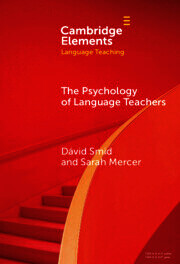
Takes stock of the rapidly expanding field of language teacher psychology by focusing on three domains: cognition, affect, motivation.
MoreLong description:
This Element has three main aims. First, the authors wish to synthesize research on language teacher psychology to provide state-of-the-art insights into the topic and identify possible avenues of scholarship. They do so by adopting a trilogy of mind perspective, which helps organize aspects of teacher psychology into three domains: cognition, affect, and motivation. Second, the overview of the literature outlines key issues, identifies gaps in current understandings and scholarship, and it also introduces less common constructs (e.g., flow, collective efficacy beliefs, and attributions) to inspire future research in this area. Third, the authors intend to reflect on practical implications for practitioners, language teacher educators, preservice teachers, and policymakers of the research to date. Rather than offering a definitive account, the authors seek to open dialogue and encourage further research and practice to ensure language teachers in all contexts receive the recognition and thus support they deserve.
MoreTable of Contents:
1. Introduction; 2. Cognition and metacognition; 3. Affect and emotions; 4. Motivation and engagement; 5. Conclusion; References.
More
