

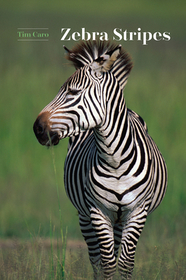
Zebra Stripes
- Publisher's listprice GBP 39.00
-
18 632 Ft (17 745 Ft + 5% VAT)
The price is estimated because at the time of ordering we do not know what conversion rates will apply to HUF / product currency when the book arrives. In case HUF is weaker, the price increases slightly, in case HUF is stronger, the price goes lower slightly.
- Discount 10% (cc. 1 863 Ft off)
- Discounted price 16 769 Ft (15 971 Ft + 5% VAT)
Subcribe now and take benefit of a favourable price.
Subscribe
18 632 Ft

Availability
Estimated delivery time: Expected time of arrival: end of January 2026.
Not in stock at Prospero.
Why don't you give exact delivery time?
Delivery time is estimated on our previous experiences. We give estimations only, because we order from outside Hungary, and the delivery time mainly depends on how quickly the publisher supplies the book. Faster or slower deliveries both happen, but we do our best to supply as quickly as possible.
Product details:
- Publisher University of Chicago Press
- Date of Publication 7 February 2017
- ISBN 9780226411019
- Binding Hardback
- No. of pages320 pages
- Size 232x162x25 mm
- Weight 672 g
- Language English 0
Categories
Short description:
From eminent biologists like Alfred Russel Wallace and Charles Darwin to famous authors such as Rudyard Kipling in his "Just So Stories", many people have asked, "Why do zebras have stripes?" There are many explanations, but until now hardly any have been seriously addressed or even tested. In Zebra Stripes, Tim Caro takes readers through a decade of painstaking fieldwork examining the significance of black-and-white striping and, after systematically dismissing every hypothesis for these markings with new data, he arrives at a surprising conclusion: zebra markings are nature's defense against biting fly annoyance. Popular explanations for stripes range from camouflage to confusion of predators, social facilitation, and even temperature regulation. It is a serious challenge to test these proposals on large animals living in the wild, but using a combination of careful observations, simple field experiments, comparative information, and logic, Caro is able to weigh up the pros and cons of each idea. Eventually – driven by experiments showing that biting flies avoid landing on striped surfaces, observations that striping is most intense where biting flies are abundant, and knowledge of zebras' susceptibility to biting flies and vulnerability to the diseases that flies carry – Caro concludes that black-and-white stripes are an adaptation to thwart biting fly attack. Not just a tale of one scientist's quest to solve a classic mystery of biology, "Zebra Stripes" is also a testament to the tremendous value of longitudinal research in behavioral ecology, demonstrating how observation, experiment, and comparative research can together reshape our understanding of the natural world.
MoreLong description:
From eminent biologists like Alfred Russel Wallace and Charles Darwin to famous authors such as Rudyard Kipling in his "Just So Stories", many people have asked, "Why do zebras have stripes?" There are many explanations, but until now hardly any have been seriously addressed or even tested. In Zebra Stripes, Tim Caro takes readers through a decade of painstaking fieldwork examining the significance of black-and-white striping and, after systematically dismissing every hypothesis for these markings with new data, he arrives at a surprising conclusion: zebra markings are nature's defense against biting fly annoyance. Popular explanations for stripes range from camouflage to confusion of predators, social facilitation, and even temperature regulation. It is a serious challenge to test these proposals on large animals living in the wild, but using a combination of careful observations, simple field experiments, comparative information, and logic, Caro is able to weigh up the pros and cons of each idea. Eventually – driven by experiments showing that biting flies avoid landing on striped surfaces, observations that striping is most intense where biting flies are abundant, and knowledge of zebras' susceptibility to biting flies and vulnerability to the diseases that flies carry – Caro concludes that black-and-white stripes are an adaptation to thwart biting fly attack. Not just a tale of one scientist's quest to solve a classic mystery of biology, "Zebra Stripes" is also a testament to the tremendous value of longitudinal research in behavioral ecology, demonstrating how observation, experiment, and comparative research can together reshape our understanding of the natural world.
More
