

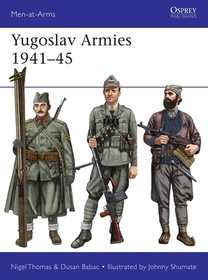
Yugoslav Armies 1941?45
Series: Men-at-Arms; 542;
-
GET 18% OFF
- Publisher's listprice GBP 12.99
-
5 864 Ft (5 585 Ft + 5% VAT)
The price is estimated because at the time of ordering we do not know what conversion rates will apply to HUF / product currency when the book arrives. In case HUF is weaker, the price increases slightly, in case HUF is stronger, the price goes lower slightly.
- Discount 18% (cc. 1 055 Ft off)
- Discounted price 4 809 Ft (4 580 Ft + 5% VAT)
- Discount is valid until: 31 October 2026
4 809 Ft

Availability
printed on demand
Why don't you give exact delivery time?
Delivery time is estimated on our previous experiences. We give estimations only, because we order from outside Hungary, and the delivery time mainly depends on how quickly the publisher supplies the book. Faster or slower deliveries both happen, but we do our best to supply as quickly as possible.
Product details:
- Publisher Bloomsbury Publishing (UK)
- Date of Publication 20 January 2022
- Number of Volumes Paperback
- ISBN 9781472842039
- Binding Paperback
- No. of pages48 pages
- Size 246x182x6 mm
- Weight 160 g
- Language English
- Illustrations Colour plates; black & white illustrations. 829
Categories
Long description:
In March 1941, an anti-German coup in the Kingdom of Yugoslavia prompted Hitler to order an invasion using allied Italian, Hungarian, Bulgarian and Romanian forces. Operation Marita was an invasion of Yugoslavia and simultaneously Greece.
At the same time, the constituent region of Croatia broke away from Yugoslavia and joined the Axis powers. Royal Yugoslav armed forces, despite advancing against the Italians in Albania were forced to surrender after 11 days' fighting and some 1,000 soldiers, airmen and sailors escaped to British-occupied Egypt to form Free Yugoslav units. From there, guerrilla resistance to the Axis occupiers broke out and continued with increasing strength until the end of the war under Mihailovic's royalist 'Chetniks' and Tito's Communist 'Partisans' (both supported by Britain).
However, hostilities between the two movements eventually led to the Chetniks entering into local agreements with Italian occupation forces and Britain switching its support entirely to the Partisans. The advance of the Red Army increased Partisan strength and, during 1944-45, they created what could be described as a lightly equipped conventional army.
Featuring meticulously-drawn illustrations of different insignia, uniforms and equipment from each faction, this volume describes, in detail, both the political and military implications of the war and how it was fought, setting the scene for the subsequent rise of Tito to power within Yugoslavia.
Table of Contents:
INTRODUCTION
-Birth of the Yugoslav state
-Inter-war developments
THE YUGOSLAV ARMY IN 1941
-Army Groups
-Uniforms
-Branch-specific items
-Rank titles & service-uniform insignia
THE APRIL WAR, 6-18 APRIL, 1941
-Order of battle & anticipated plans
-Campaigns
ROYAL YUGOSLAV FORCES IN THE MIDDLE EAST, 1941-45
-Royal Guards Battalion
- Uniforms & insignia
-7 (Yugoslavian) Troop, No. 10 (Inter-Allied) Commando
-Yugoslav Air Force
YUGOSLAV ARMY IN THE HOMELAND, 1941-45
-1941: Formation of the Chetniks
-1942: Establishment
-1943: Civil war
-1944: The defence of Serbia
-1945: Defeat
-Uniforms & insignia
YUGOSLAV PEOPLE'S LIBERATION ARMY, 1941-45
-1941: Organization
-1942: Organization
-1943: Organization
-1944: Campaigns
-1945: Campaigns
-Uniforms & insignia
SELECT BIBLIOGRAPHY
PLATE COMMENTARIES
INDEX

