

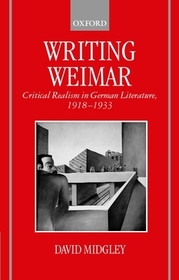
Writing Weimar
Critical Realism in German Literature, 1918-1933
- Publisher's listprice GBP 67.00
-
32 009 Ft (30 485 Ft + 5% VAT)
The price is estimated because at the time of ordering we do not know what conversion rates will apply to HUF / product currency when the book arrives. In case HUF is weaker, the price increases slightly, in case HUF is stronger, the price goes lower slightly.
- Discount 10% (cc. 3 201 Ft off)
- Discounted price 28 808 Ft (27 437 Ft + 5% VAT)
Subcribe now and take benefit of a favourable price.
Subscribe
32 009 Ft

Availability
printed on demand
Why don't you give exact delivery time?
Delivery time is estimated on our previous experiences. We give estimations only, because we order from outside Hungary, and the delivery time mainly depends on how quickly the publisher supplies the book. Faster or slower deliveries both happen, but we do our best to supply as quickly as possible.
Product details:
- Publisher OUP Oxford
- Date of Publication 9 March 2000
- ISBN 9780198151791
- Binding Hardback
- No. of pages400 pages
- Size 224x146x27 mm
- Weight 677 g
- Language English
- Illustrations 8 halftones 0
Categories
Short description:
Writing Weimar shows how German literature between 1918 and 1933 is related both to the politics of the time and to longer-term cultural developments. Individual chapters discuss developments in particular genres and the significance of the term Neue Sachlichkeit, as well as the treatment of the city, technology, and the First World War.
MoreLong description:
The years of the Weimar Republic saw complex cultural change in Germany as well as political turmoil. Writing Weimar draws on the large amount of research done on the period since the 1980s in order to show how literary writers developed critical perspectives on the social and political issues of the time, and how those perspectives were related to longer-term developments in German culture which run beyond the watershed events of 1918 and 1933. Individual chapters discuss the dominant trends in the poetry, the theatre, and the novel, as well as the literary representation of the city, of technology, and of the First World War. The book also sheds new light on one of the abiding mysteries of German culture in the 1920s: precisely what were the implications of the term Neue Sachlichkeit as it came to be applied to the cultural trends of the time?
The book succeeds in giving a sense of the breadth of literary production during the time, and the various literary concerns of writers come nicely to the fore ... There are some brilliant moments when Midgley manages to give a clear and concise explanation of such events that sparked and influenced well-known literary debates now often cited out of context.
Table of Contents:
Introduction: Writing under Weimar
'Neue Sahclichkeit': The Career of an Idea
Poetry for Everyday Use?
The Theatre as Political Community
The Novel I: Representing the Times
The Novel II: Paths of Disillusionment
Remembering the War
The City and the Country
Technology versus Humanity
Epilogue
Bibliography
Index

